Overview
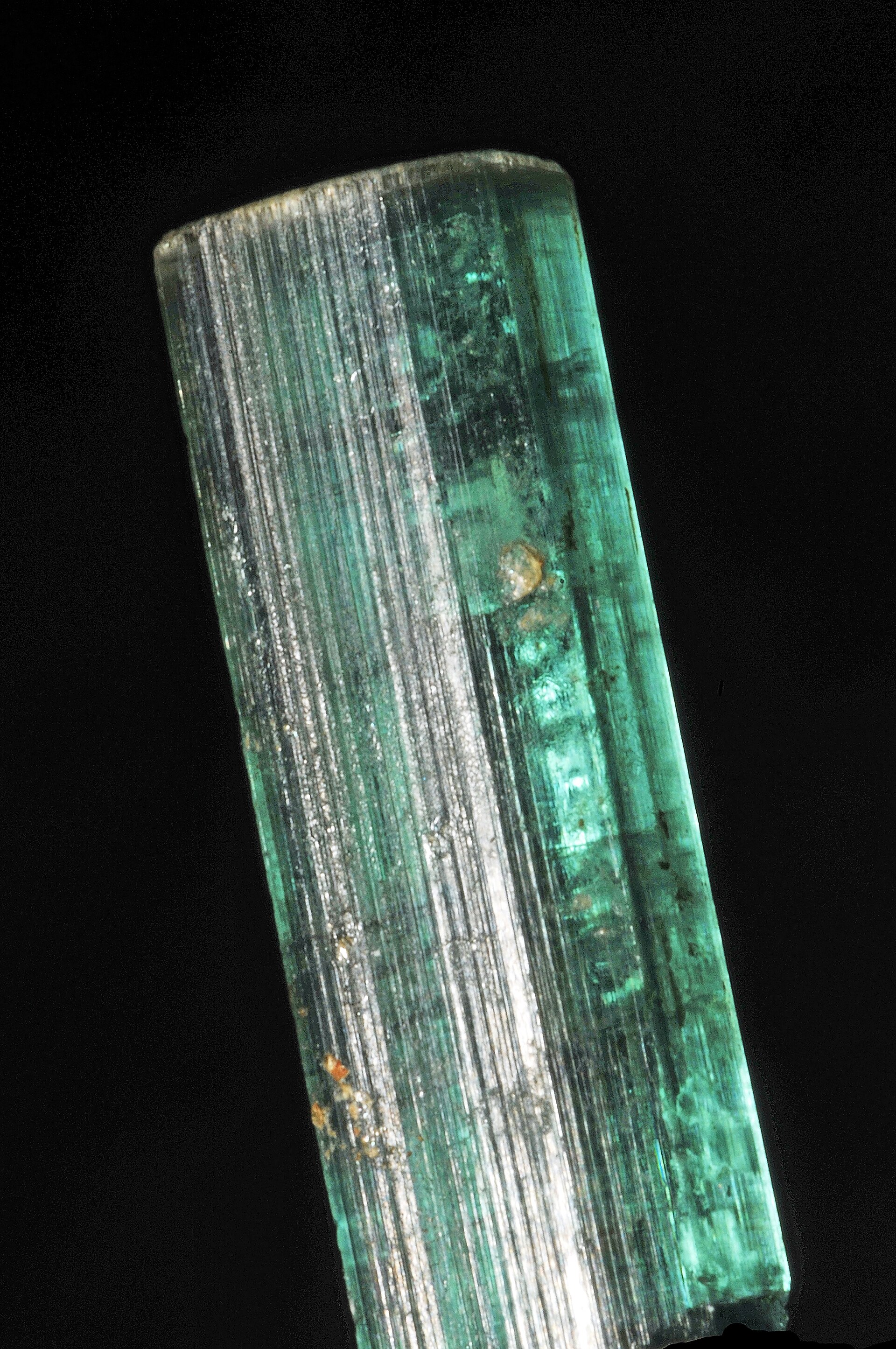
Tourmaline is the most chemically complex gem species — it's actually a group of 14+ related minerals sharing a common borosilicate framework but varying widely in metal content. Schorl (black, iron-rich) is the most abundant; elbaite (lithium-aluminium) is the gem-quality variety that produces the spectacular pink (rubellite), green (verdelite), blue (indicolite), and rare neon-blue Paraíba colours.
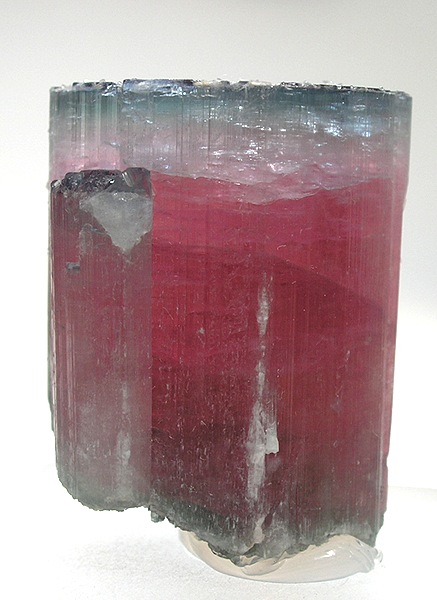
A single tourmaline crystal can show multiple colours along its length ("bicolour" and "watermelon" varieties) or in zones, because growing conditions change subtly. The most extraordinary tourmaline is Paraíba tourmaline — copper-bearing elbaite from Brazil that glows with electric blue-green saturation under any light. Discovered in 1989 in Mina da Batalha, Paraíba state, it commands the highest per-carat prices of any coloured gemstone — top stones reach $50,000-$100,000 per carat for clean material.
Pakistan (Stak Nala, Chitral) and Afghanistan (Paprok in Nuristan) produce world-class elbaite tourmaline in pink, green, and bicolour, often with sharp gem-quality terminations on quartz/feldspar matrix.
Formation
Tourmaline crystallises in granitic pegmatites that are rich in boron — the rare ingredient that distinguishes tourmaline from other Al-silicates. Boron, lithium, fluorine and water are concentrated in late-stage pegmatite fluids; as the melt cools, tourmaline grows in cavities (miarolitic vugs) over thousands of years.
Famous pegmatite belts: Minas Gerais (Brazil) — the world's largest gem tourmaline source, with deposits at Cruzeiro, Aricanga, Pederneira producing massive multi-colour crystals; Paprok and Nuristan (Afghanistan) — extraordinary pink/green elbaite crystals discovered in the 1980s; Stak Nala (Pakistan) — pink and green elbaite; Pala District (San Diego, USA) — historic pink tourmaline source for Chinese empress Cixi.
Paraíba-type tourmaline (copper-bearing) forms in unique pegmatites where the source granitic melt contained anomalous copper — only confirmed in Brazil (Paraíba and Rio Grande do Norte), Mozambique (Mavuco) and Nigeria.
Varieties
Schorl — black iron-tourmaline; most abundant, used in jewellery and metaphysically as "protection stone".
Dravite — brown magnesium-tourmaline; specimen interest.
Elbaite — gem variety, lithium-bearing; produces all the famous colours:
- Rubellite — pink to red elbaite, named "ruby-like"
- Verdelite — green elbaite
- Indicolite — blue elbaite
- Achroite — colourless elbaite (rare)
- Paraíba tourmaline — copper-bearing neon blue/green
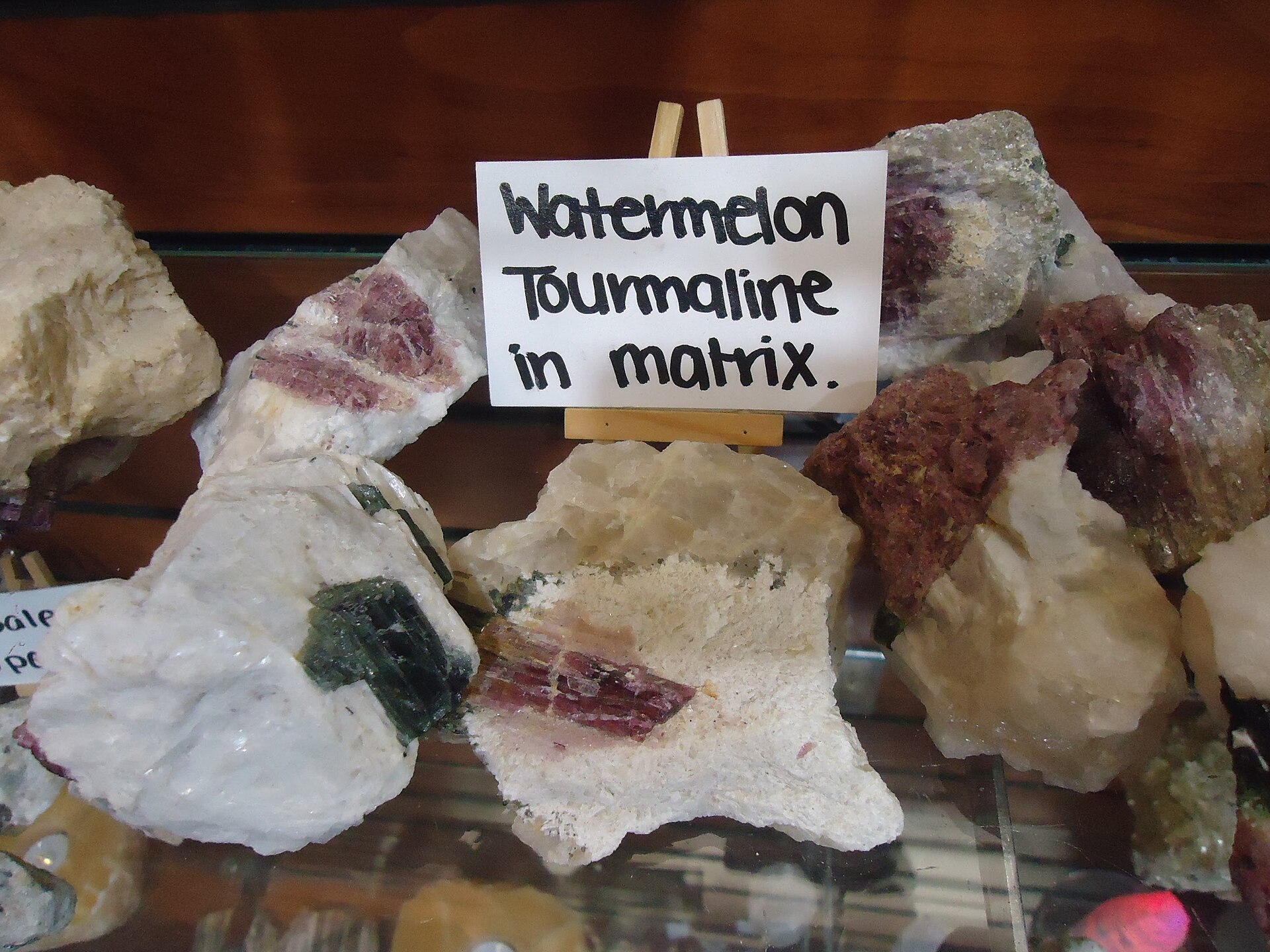
Watermelon tourmaline — bicolour pink core + green rim, looks like watermelon slice when cut perpendicular.
Bicolour / parti-colour tourmaline — any combination of colours along the crystal length.
Cat's eye tourmaline — chatoyant variety with parallel inclusions.
Liddicoatite — calcium-rich elbaite variant, Madagascar speciality, famous for "star" colour zoning patterns visible in cross-sections.
How to identify
Tourmaline identification:
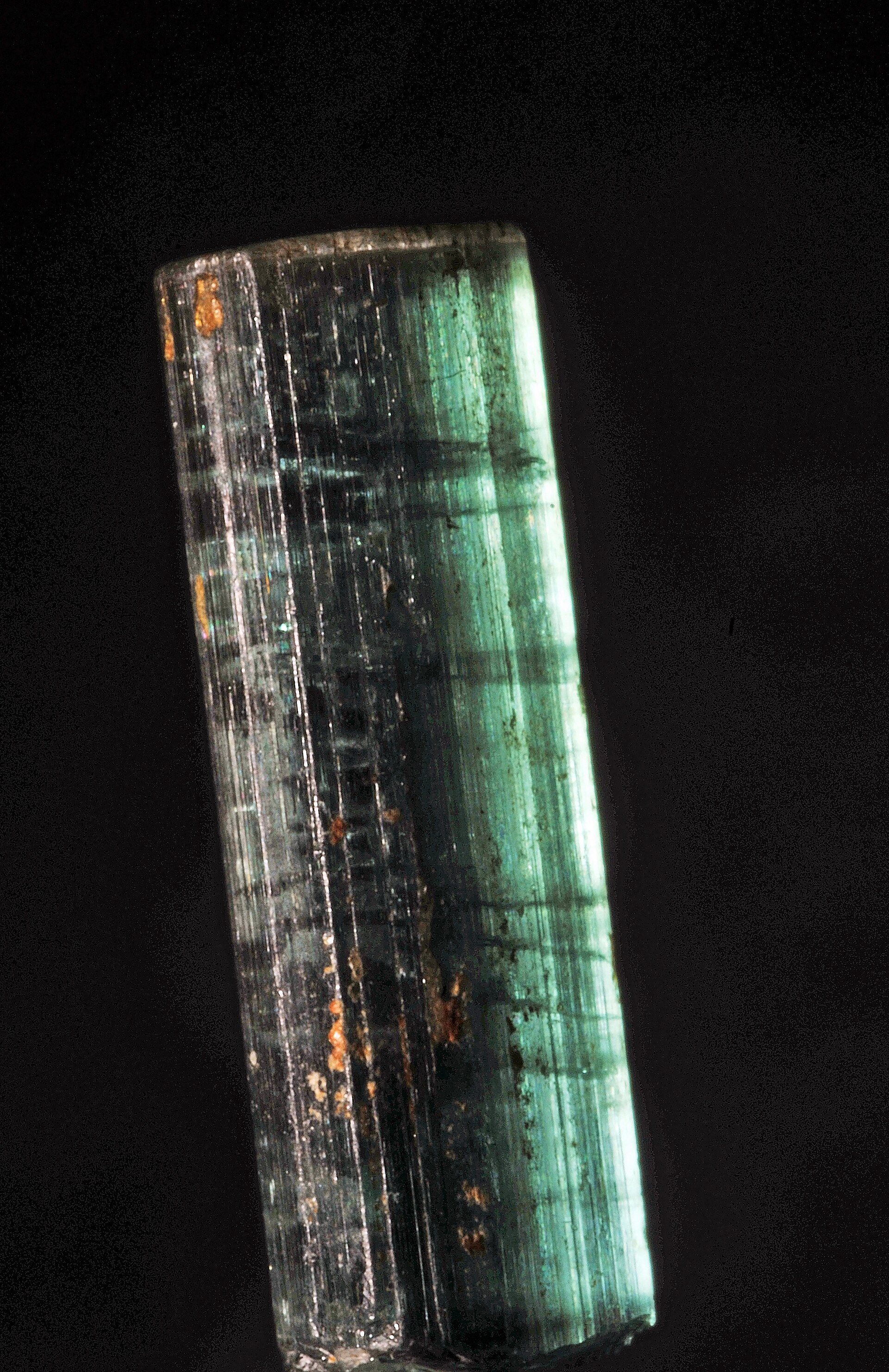
- Distinctive elongated prismatic habit with triangular cross-section and longitudinally striated faces — diagnostic of the species.
- Hardness 7–7.5 — scratches glass; cannot be scratched by topaz.
- Strong pleochroism: two distinct colours when viewed along different axes — diagnostic.
- Specific gravity 3.0–3.3 — heavier than quartz, lighter than zircon.
- Refractive index 1.624–1.644 — birefringence 0.018-0.040, very strong, visible doubling.
- Pyroelectric and piezoelectric — heating or pressing produces electric charge (used in historical heating-static experiments).
Common confusions: green tourmaline vs emerald (emerald has weaker pleochroism, different RI, often heavier inclusions); rubellite vs ruby (ruby is much harder, different RI, lacks tourmaline pleochroism); black tourmaline vs obsidian (obsidian is amorphous glass, hardness 5).
Paraíba tourmaline requires GIA, AGL or SSEF certification for stones over 0.5 ct — origin (Brazil vs Mozambique vs Nigeria) affects price 2-5x.
Meaning & metaphysical properties
Tourmaline has the most varied metaphysical associations of any gem species because each colour carries different meaning:
- Black tourmaline (schorl) — foremost protective stone, associated with the root chakra; absorbs negative energy and EMF; the single most commonly carried "protection stone" in modern crystal practice.
- Pink tourmaline (rubellite) — heart chakra, emotional healing, self-love.
- Green tourmaline (verdelite) — heart chakra, physical healing, prosperity.
- Blue tourmaline (indicolite) — throat chakra, communication, truth.
- Watermelon tourmaline — heart chakra balance, integration of opposites.
- Paraíba tourmaline — considered the highest vibrational tourmaline, used in advanced energy work.
Tourmaline has been valued throughout history but was confused with other gems until the 1700s. Egyptian legend held that tourmaline "passed through a rainbow" on its journey from earth's centre, gathering its colours.
Care & cleaning
Tourmaline is durable but requires reasonable care:
- Clean with warm soapy water + soft brush.
- Ultrasonic cleaners generally safe for clean stones; avoid for included material or oiled treatments.
- Avoid sudden temperature changes (pyroelectric property can cause stress).
- Some heat-treatment is standard (especially for Paraíba and rubellite); avoid further heat.
- Avoid harsh chemicals including chlorine and acetone for treated stones.
Pink and red tourmaline can be sensitive to UV — display away from prolonged direct sunlight.
Gallery
Looking to buy a tourmaline specimen?
Our small curated catalogue of tourmaline specimens is published on Etsy with worldwide shipping.
Browse Gemsprings on Etsy