Overview
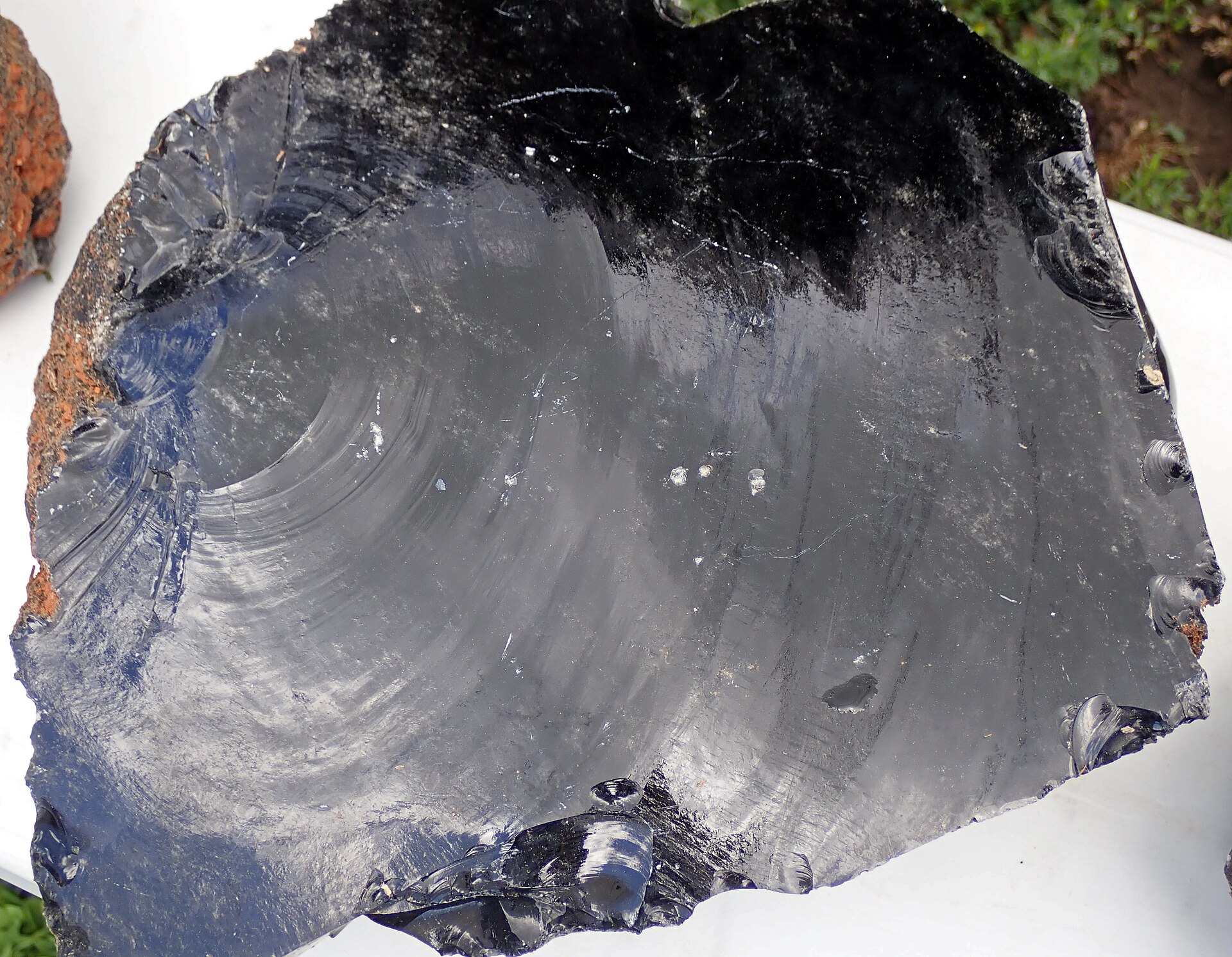
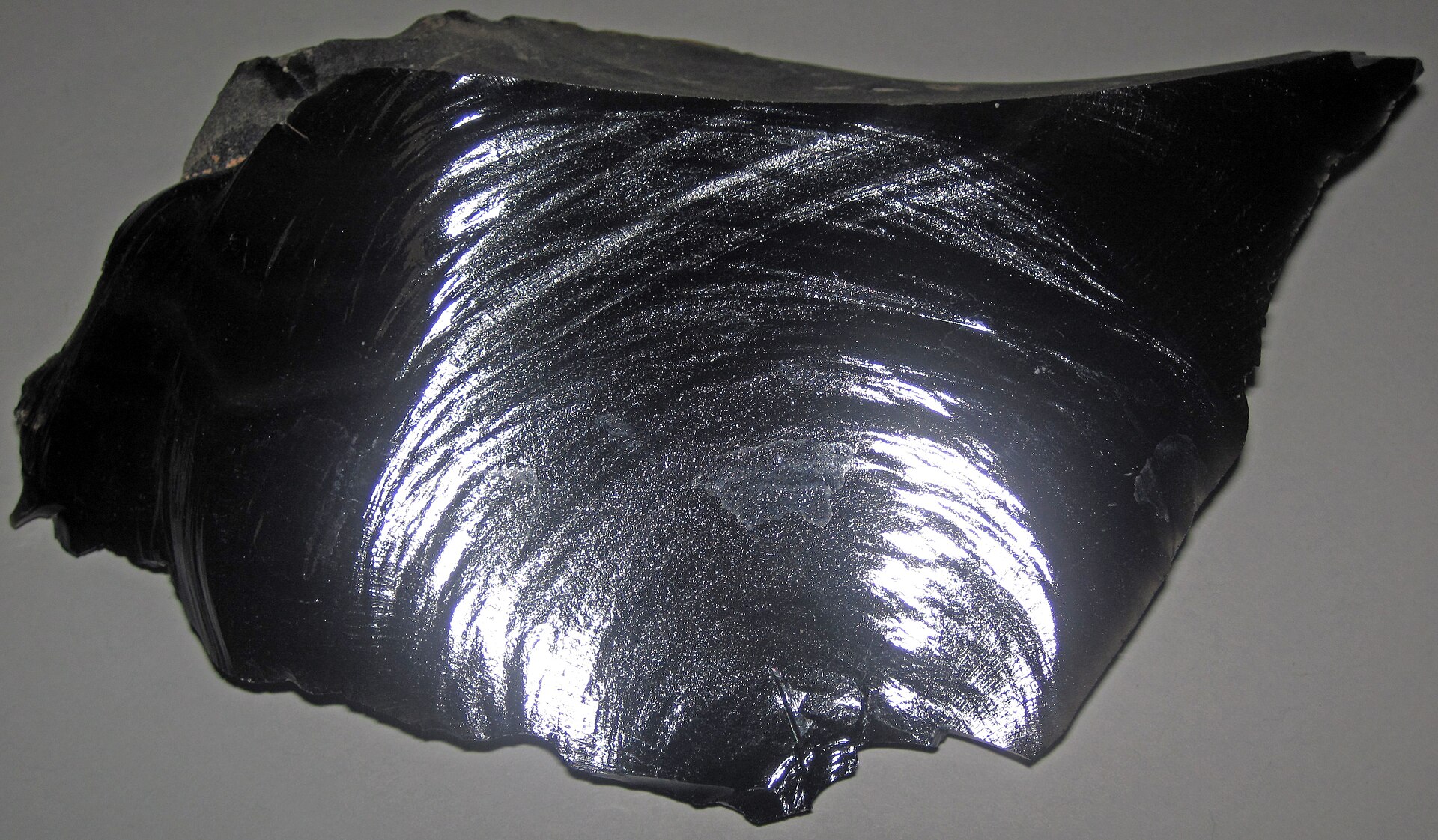
Obsidian is natural volcanic glass formed when rhyolitic lava (high-silica magma) cools so rapidly that no crystal structure develops. The result is a homogeneous amorphous solid — chemically silica plus minor metal oxides, structurally a glass. It is technically classified as a mineraloid rather than a true mineral because it lacks crystalline order.
Obsidian has been used by humans for stone tools, weapons, mirrors and ritual objects for over 700,000 years — longer than any other gemstone. Its conchoidal fracture produces edges sharper than surgical steel (around 3 nm at the edge — finer than any sharpened metal blade), and pre-Columbian Aztec and Maya cultures created elaborate obsidian sacrificial knives, mirrors and prismatic blades.
The volcanic regions of central Mexico (Pachuca, Teotihuacán) supplied obsidian to civilisations across Mesoamerica for 3,000 years; Aegean obsidian from Melos was traded across the Mediterranean from 8000 BCE; Anatolian obsidian (Çatalhöyük) was distributed across the Near East.
Formation
Obsidian forms during rapid quenching of high-silica (rhyolitic) lava flows — typically when the lava flows into water, snow, or surfaces of much cooler rock. The rapid cooling prevents nucleation of crystals; instead the lava freezes as a homogeneous glass.
Obsidian is geologically young — most natural obsidian is less than a few million years old, because over geological time glass slowly devitrifies (converts to microscopic crystals of cristobalite and feldspar) losing the glassy texture. The world's main producing regions are all areas of recent or active volcanism: the Pacific Ring of Fire, the Mediterranean volcanic arc, Iceland, the East African Rift.
Apache Tears are small rounded obsidian pebbles eroded from volcanic deposits — they're abundant in the southwestern USA.
Varieties
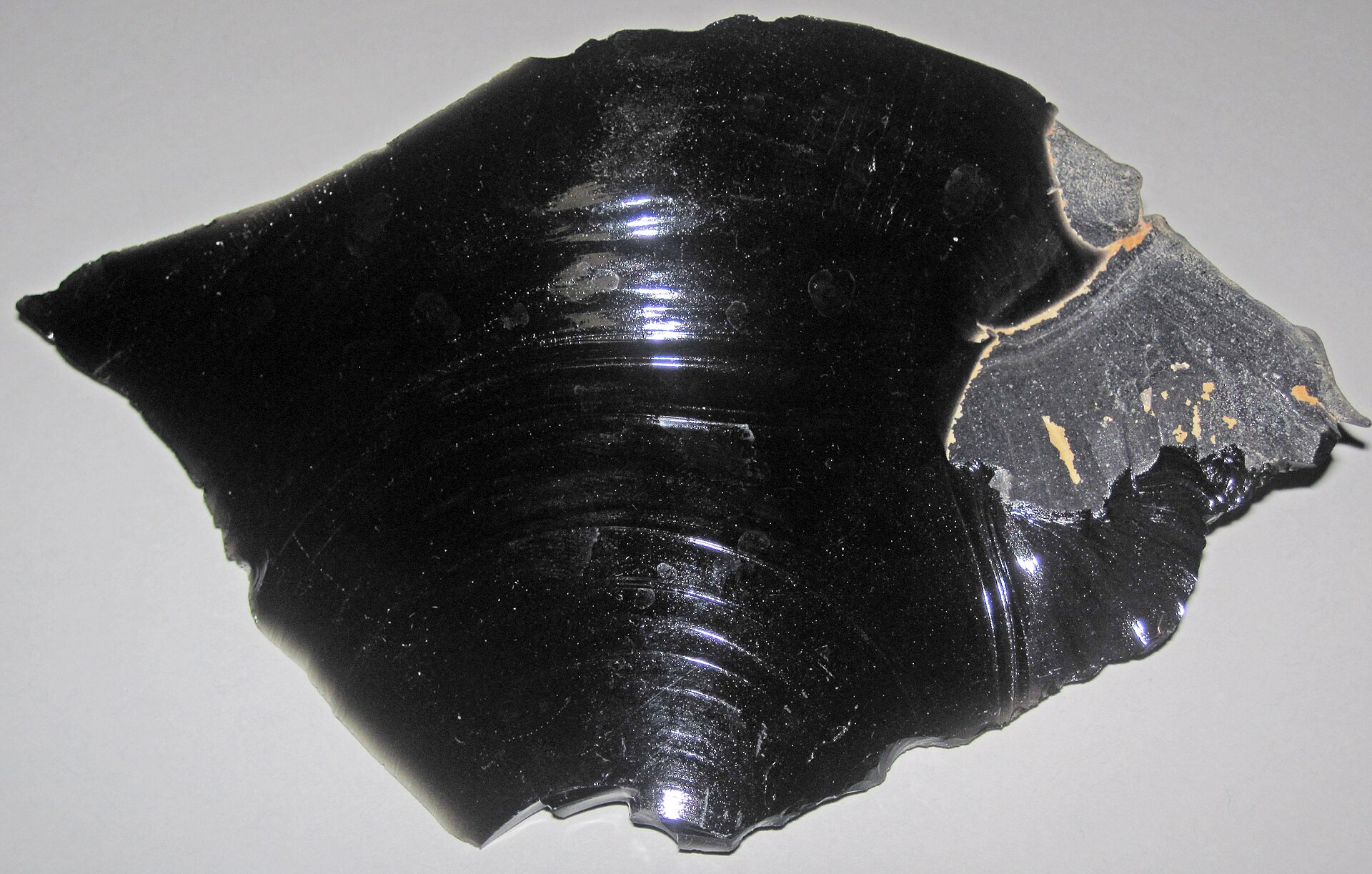
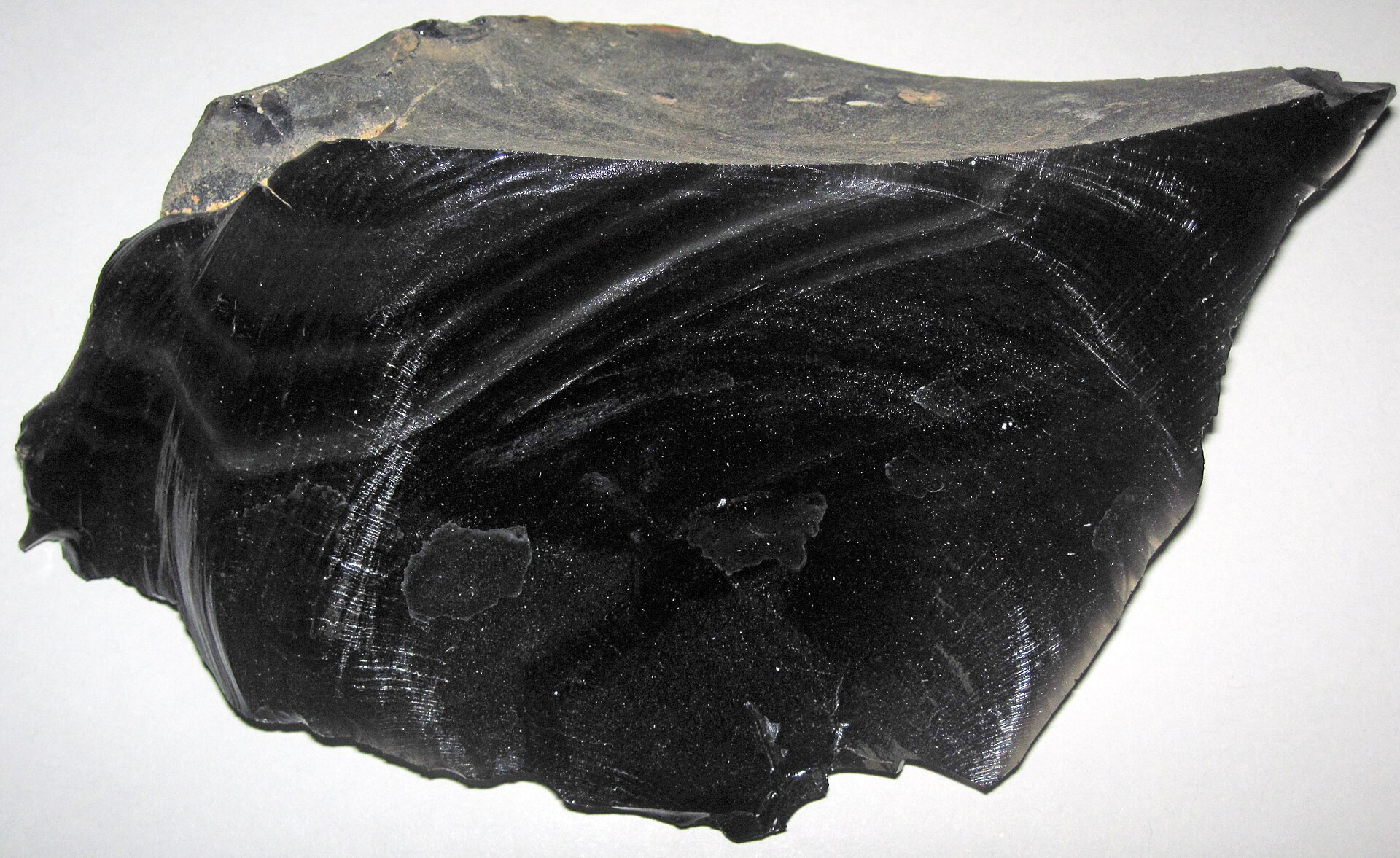
Black obsidian — the standard pure form; deep glossy black, opaque to translucent in thin slabs.
Mahogany obsidian — black with red-brown banding from iron oxide inclusions; Oregon and Mexico.
Snowflake obsidian — black with white spherulitic patches of cristobalite crystals (early devitrification); ornamental favourite.
Rainbow obsidian — shows iridescent gold/green/purple sheen at specific angles; from Jalisco Mexico, caused by thin parallel layers of nanocrystals.
Gold sheen obsidian — golden iridescence; from Mexico.
Silver sheen obsidian — silvery iridescence; Mexico, Armenia.
Apache Tears — small (1–5 cm) rounded obsidian nodules; tumbled smooth from natural weathering. Sold as inexpensive collector items.
Mahogany obsidian — banded black + red-brown from iron oxide.
How to identify
Obsidian identification:
- Vitreous glass-like luster — obviously a glass to the eye.
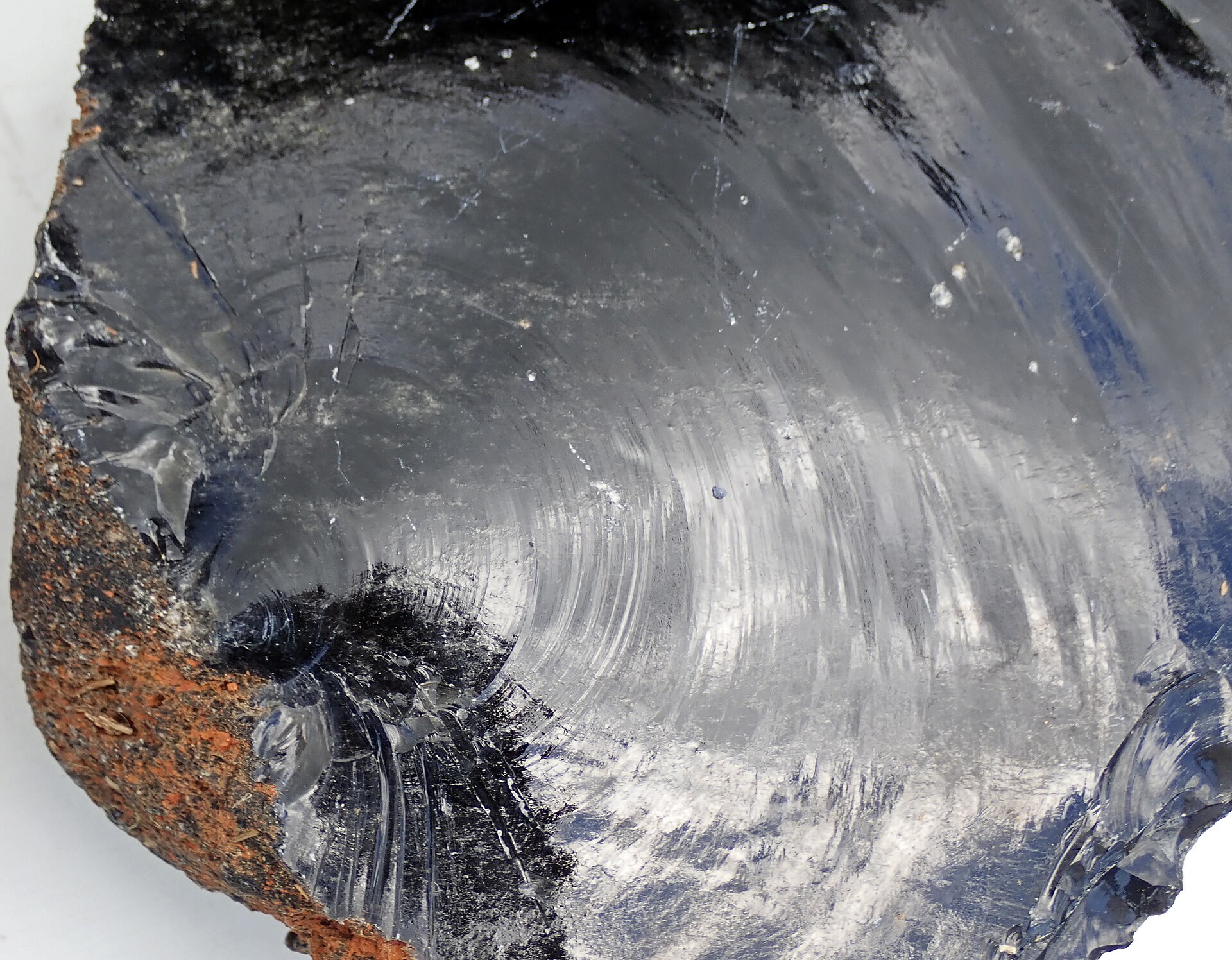
- Conchoidal fracture with razor-sharp edges — diagnostic.
- Hardness 5–6 — scratches with steel knife.
- Specific gravity 2.35–2.50 — significantly lower than crystallised silica (quartz SG 2.65).
- Amorphous structure — no crystals visible under any magnification.
- Often shows flow lines in mass — diagnostic of viscous lava cooling.
Common confusions: black tourmaline (schorl) (crystalline, hardness 7, prismatic habit); jet (organic, much lighter SG 1.3, burns in flame); black glass (manufactured) — chemically similar but distinguishable by inclusions (natural obsidian has bubble trains, manufactured glass typically lacks them).
"Apache Tears" are simply small rounded obsidian pebbles — same material as larger obsidian.
Meaning & metaphysical properties
Obsidian is one of the foremost protective and grounding stones in modern metaphysical traditions — associated with the root chakra and considered a master mirror stone for revealing hidden truth, shadow self, and inner conflict. Different colour varieties have different meanings:
- Black obsidian — protection, grounding, "psychic mirror"
- Snowflake obsidian — balance, patience
- Mahogany obsidian — vitality, sexual energy
- Rainbow obsidian — joy, attraction of love
- Apache tears — grief release, comfort during loss
Mesoamerican cultures used obsidian mirrors for divination — Aztec priests gazed into polished black obsidian discs to consult the god Tezcatlipoca ("Smoking Mirror"). Roman scribes carried obsidian inkpots; medieval European magicians used black mirrors made from polished obsidian for scrying.
Care & cleaning
Obsidian is durable but with caveats:
- Hardness 5.5–6 — scratches easily, store separately from harder stones.
- Conchoidal fracture — chips with sharp impact, producing razor-sharp shards (handle broken pieces carefully).
- Clean with warm soapy water and soft cloth.
- Ultrasonic and steam cleaners are safe.
- Avoid sudden temperature changes — can crack from thermal shock.
Obsidian is well-suited to pendant, earring and bead jewellery; ring use should be in protective settings due to scratching tendency. Display safely — broken obsidian edges can cut.
Gallery
Looking to buy a obsidian specimen?
Our small curated catalogue of obsidian specimens is published on Etsy with worldwide shipping.
Browse Gemsprings on Etsy