Overview
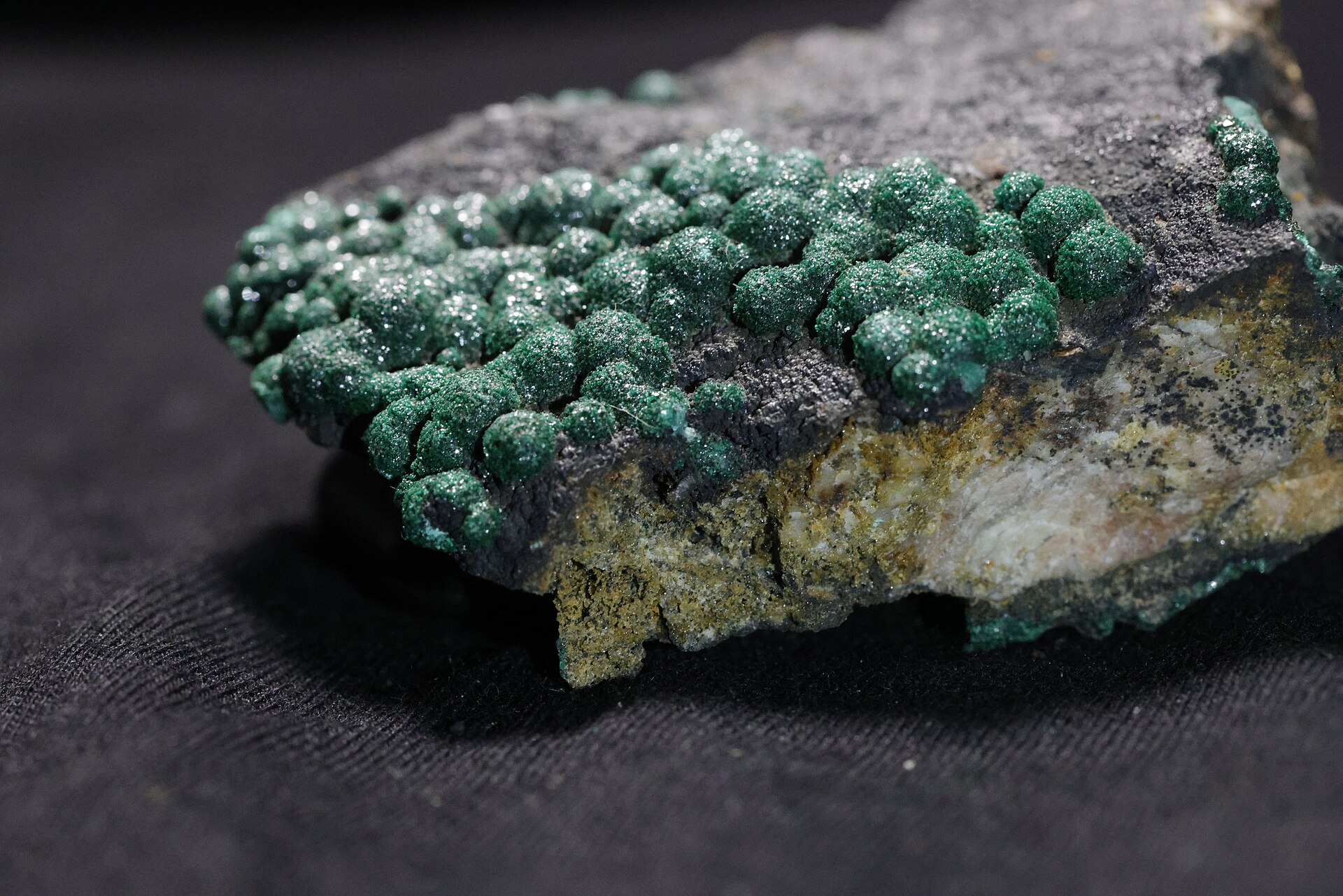
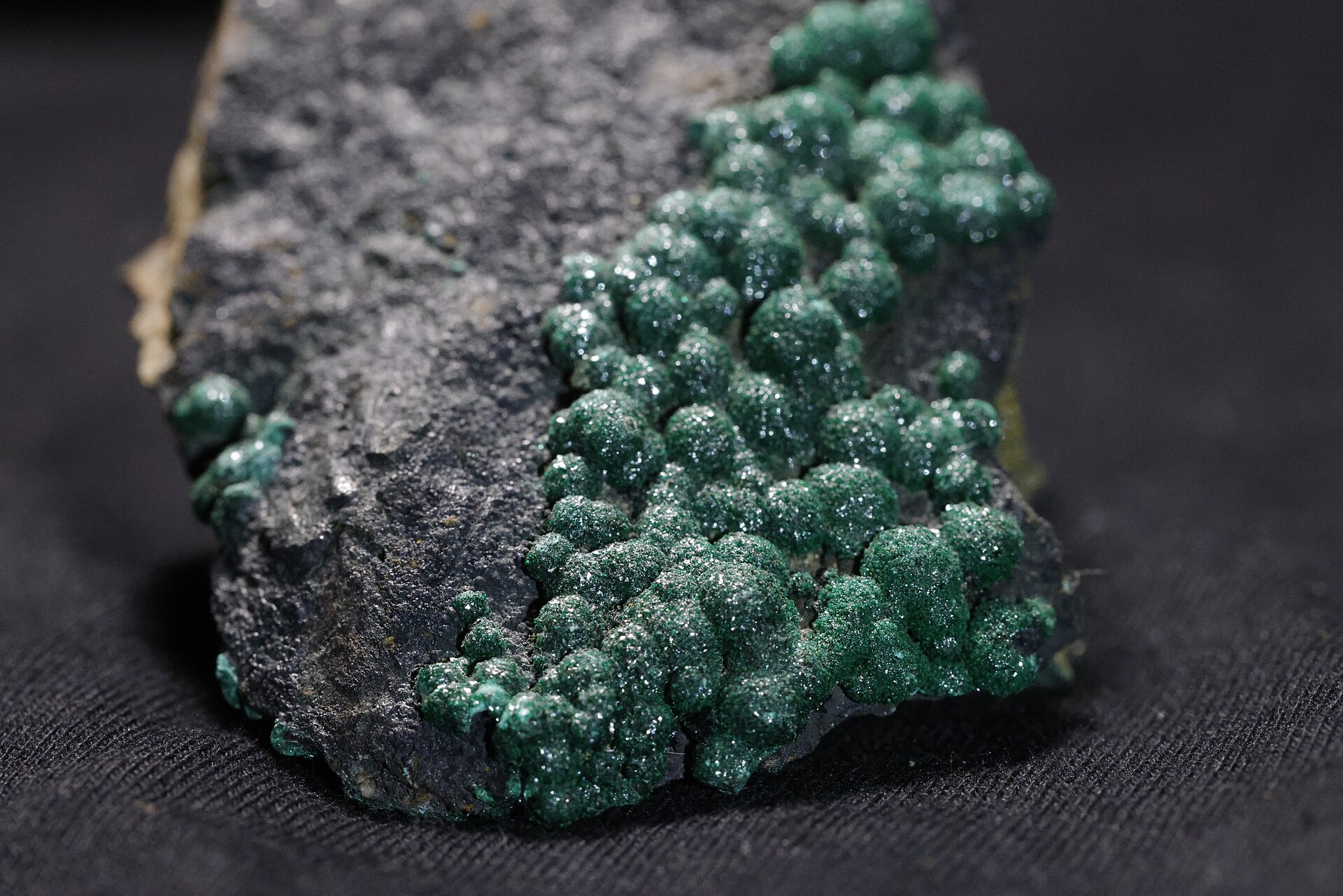
Malachite is a basic copper carbonate famous for its distinctive concentric banded green pattern — alternating light and dark green rings formed by slow precipitation from copper-bearing groundwater in cavities of weathered copper ore deposits. It is one of the most recognisable and ornamental minerals on Earth, used for jewellery, sculpture, and architectural inlay for thousands of years.
The most spectacular malachite came historically from the Ural Mountains, Russia — colossal blocks weighing several tons were extracted in the 18th-19th centuries and used to construct entire rooms at the Catherine Palace (St. Petersburg) and the malachite columns of St. Isaac's Cathedral. The Russian deposits are now largely exhausted; today ~90% of commercial malachite comes from the Democratic Republic of Congo (Katanga Province, near Kolwezi) — the world's largest copper belt.
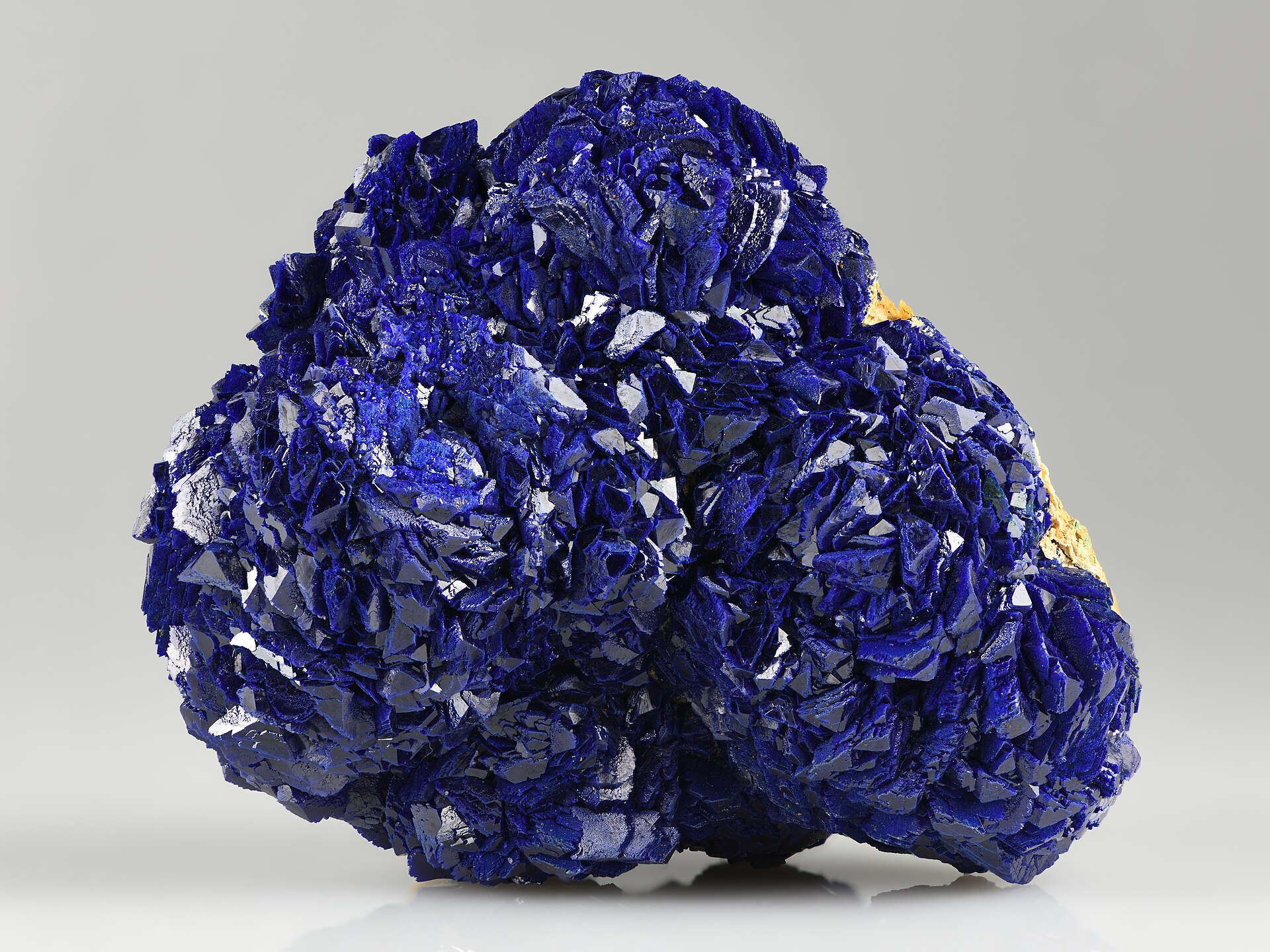
Malachite is closely associated with azurite (blue copper carbonate) which often coats or interpenetrates malachite specimens; together they form some of the most colourful display minerals in the world.
Formation
Malachite forms in the oxidation zone of copper ore deposits — the surficial layer where weathering and groundwater interact with primary copper sulfides (chalcocite, chalcopyrite, bornite). The process:
1. Surface water dissolves CO₂ from the atmosphere becoming weakly acidic.
2. The acidic water oxidises primary copper sulfides, dissolving copper as ions.
3. As the copper-rich solution percolates through limestone or carbonate-bearing rocks, the carbonate ions react with copper to precipitate malachite (and azurite where conditions favour basic carbonate).
4. Repeated cycles of dissolution and precipitation create the characteristic concentric banded patterns.
The Katanga deposits formed by weathering of the Mesoproterozoic Roan copper belt — sediments containing 5-10% copper that were uplifted and exposed to tropical weathering producing meters-thick malachite layers.
Varieties
Banded malachite — the classic concentric-pattern variety; standard commercial form.
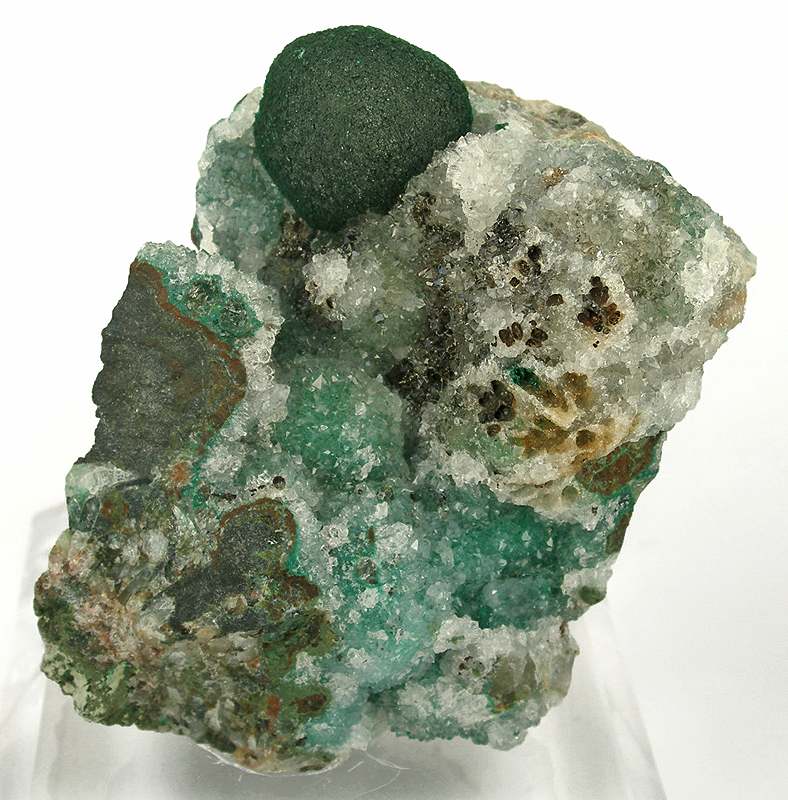
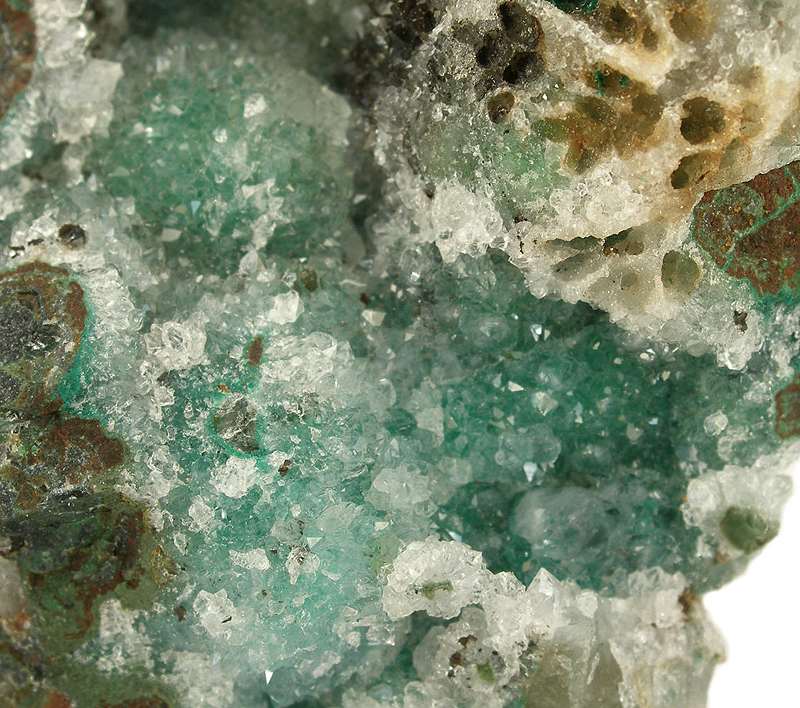
Botryoidal malachite — globular grape-like clusters; collector-favourite habit.
Fibrous malachite (velvet malachite) — silky chatoyant variety with parallel fibre orientation.
Stalactitic malachite — formed in caves and ore galleries as drip formations.
Pseudomorphic malachite — malachite replacing original azurite crystals while preserving azurite's prismatic shape; highly prized by collectors.
Azurmalachite — natural intergrowth of malachite (green) and azurite (blue) in the same specimen.
Chrysocolla in malachite — turquoise-coloured chrysocolla layers within malachite; beautiful for cabochon use.
How to identify
Malachite identification:
- Vivid green colour with banded or botryoidal structure — diagnostic.
- Hardness 3.5–4 — very soft, scratches with copper coin.
- Specific gravity 3.6–4.0 — heavy for an ornamental stone.
- Light green streak when scratched.
- Effervesces in dilute hydrochloric acid (carbonate test).
- Often associated with azurite — blue patches diagnostic of natural origin.
Common confusions: dyed howlite (lighter weight, uniform colour without natural banding); resin/plastic imitations (much lighter weight, melts under flame); chrysocolla (different chemistry, lighter colour, no banding); green agate (much harder at 7, no banded green pattern of natural malachite).
Meaning & metaphysical properties
Malachite is one of the most powerful "transformation stones" in modern metaphysical traditions — associated with the heart and solar plexus chakras and considered a strong stone of personal change and emotional processing. It is recommended for:
- Breaking unhealthy patterns and habits
- Emotional release and shadow work
- Protection from EMF and negative energy
- Manifestation of desires
In ancient Egypt malachite was sacred to Hathor and ground into the green eye-paint worn by both sexes — pigment from malachite has been identified in Egyptian cosmetic vessels dating to 4000 BCE. Greek warriors wore malachite for protection in battle. Medieval European healers used it for various complaints, though Renaissance physicians warned against ingesting it (correctly — malachite is copper-bearing and toxic if powdered and consumed).
Care & cleaning
Malachite is toxic if powdered and inhaled — handle with care:
- Soft (3.5–4) and very prone to scratching.
- Polish dust is mildly toxic — copper content. Cabochon makers should wet-sand and wear masks.
- Avoid ultrasonic and steam cleaners — soft and prone to thermal cracking.
- Clean only with damp soft cloth — never use acid, ammonia, or chlorine.
- Avoid contact with skin acids (sweat) for prolonged periods — colour can dull.
- Avoid sunlight — colour can fade slightly over years.
- Avoid water immersion — copper compounds slowly leach.
Reserve malachite jewellery for occasional wear in protective settings. Carved sculptures and spheres need careful display away from direct sun.
Gallery
Looking to buy a malachite specimen?
Our small curated catalogue of malachite specimens is published on Etsy with worldwide shipping.
Browse Gemsprings on Etsy