![Lapis lazuli mineral specimen — Figures 1-7. The Topaz. 1. Topaz 2. The same [Topaz] 3. Dark Yellow Topaz 4. Sea-green Topaz or Aqua](/minerals/img/lapis-lazuli-01.jpg)
Overview
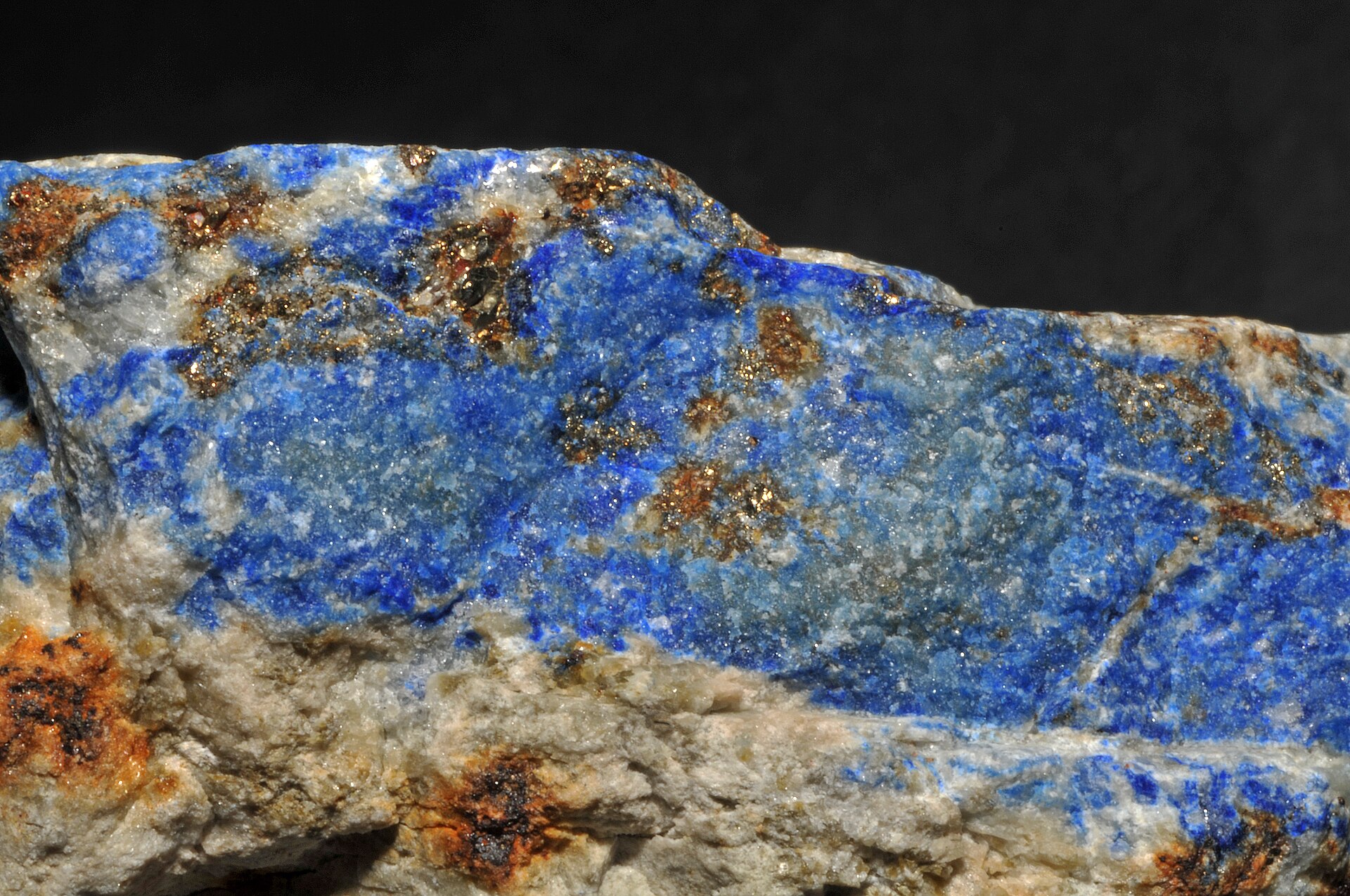
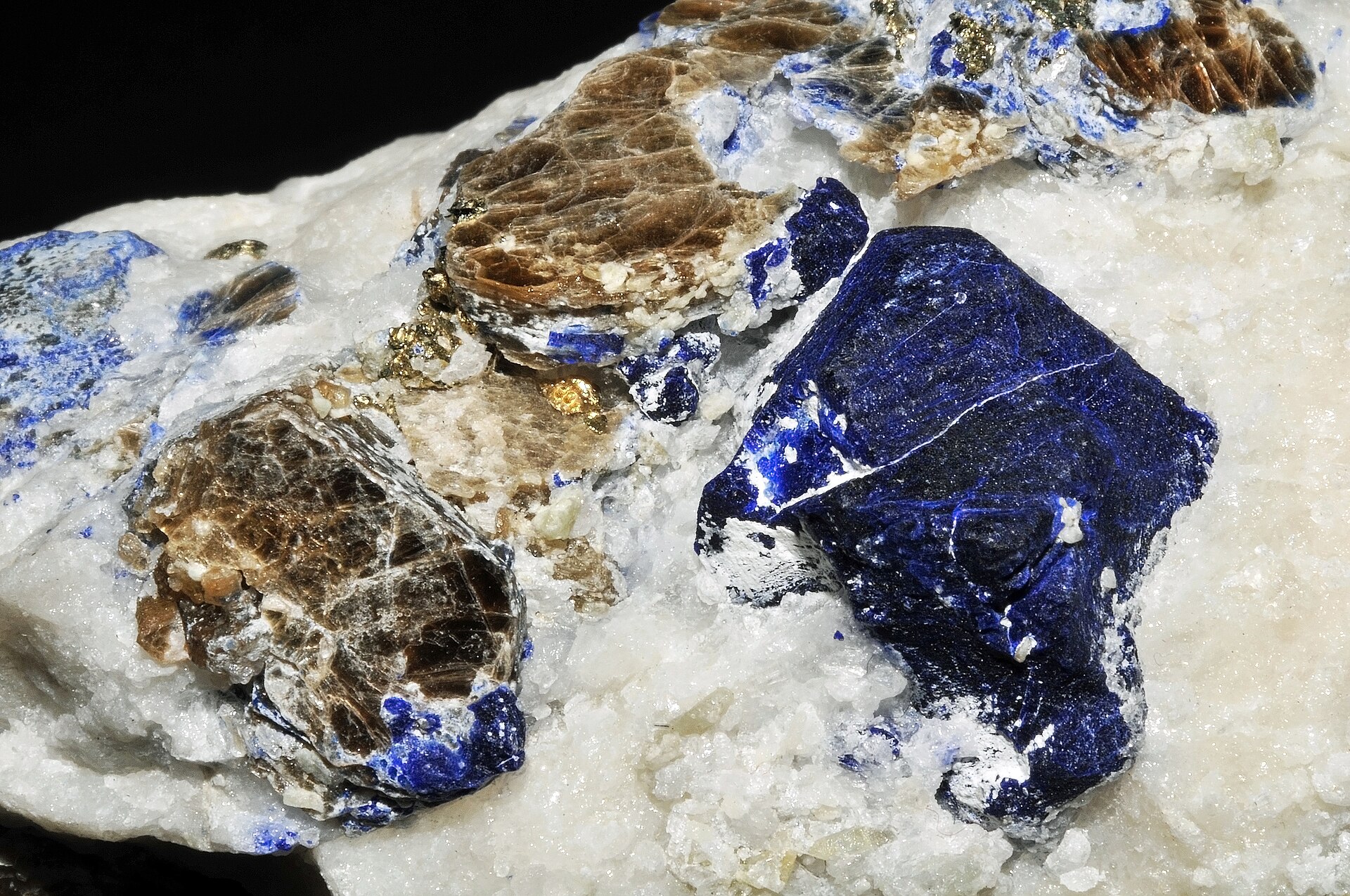
Lapis lazuli is not a single mineral but a metamorphic rock dominated by the blue feldspathoid lazurite (typically 25-40%), interspersed with calcite (white veining), pyrite (golden flecks), and minor amounts of sodalite, haüyne and diopside. The intense ultramarine blue colour comes from the sulfur radical anion (S₃⁻) trapped in the lazurite framework.
It is among the oldest mined materials on Earth — the Sar-i-Sang mines in Badakhshan, Afghanistan have been worked continuously for at least 7,000 years, supplying the lapis used in Sumerian jewellery (4500 BCE), the Egyptian Pharaohs (Tutankhamun's funeral mask), and the ultramarine pigment that Renaissance painters reserved for the Virgin Mary's robes (more expensive than gold by weight in the 14th-16th centuries).
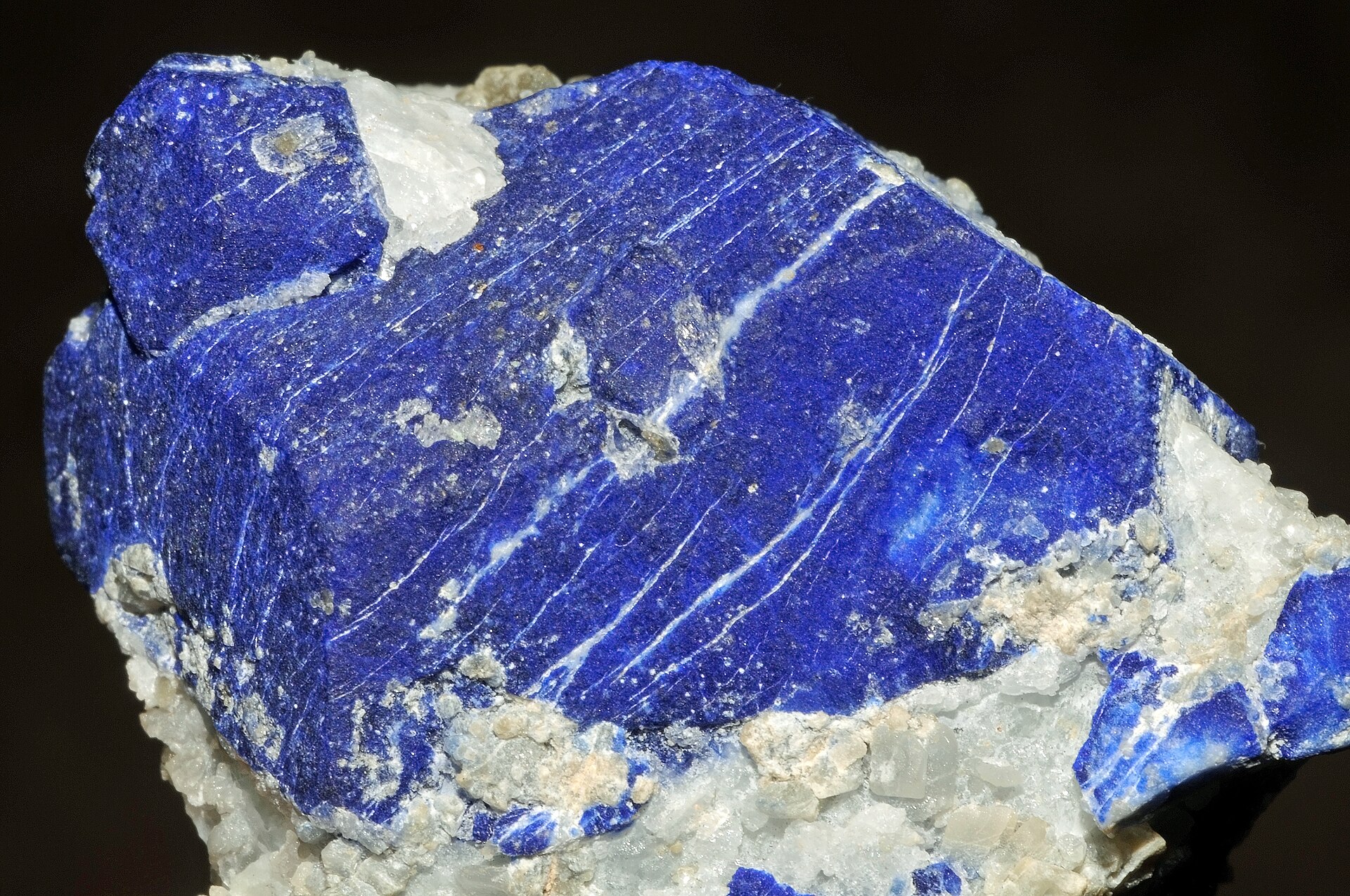
The finest lapis shows deep saturated ultramarine blue with sparse golden pyrite "stars" and minimal calcite veining. Cheaper material is paler, more calcite-streaked, or dyed.
Formation
Lapis lazuli forms by contact metamorphism of impure limestone — sulfur-bearing fluids percolating through carbonate rocks at the contact with intrusive granites convert calcite into the complex sodium-aluminium silicates that make lazurite. The unique geological coincidence (right combination of sulfur, sodium, aluminium, and calcium at moderate temperature) is exceedingly rare worldwide.
The Sar-i-Sang deposits of Badakhshan, Afghanistan formed about 24 million years ago in the contact aureole of granitic intrusions cutting through Proterozoic marble. The mines sit at 3,500 m elevation in the Hindu Kush mountains and are accessible only in summer months. The continuous mining tradition spans 7 millennia — making this arguably the world's longest-running active mining operation.
Lesser deposits in Chile (Las Flores de los Andes) and Russia (Lake Baikal area) produce paler material; American lapis from Colorado is paler with more pyrite.
Varieties
Afghan lapis (Sar-i-Sang) — the gold standard; deep saturated ultramarine with sparse pyrite, minimal calcite. Top-grade specimens from this mine define the "lapis blue" colour.
Chilean lapis — paler blue with more white calcite mottling; from Las Flores de los Andes, abundant on the market.
Russian lapis — medium blue, often with denser pyrite distribution; from south Lake Baikal region.
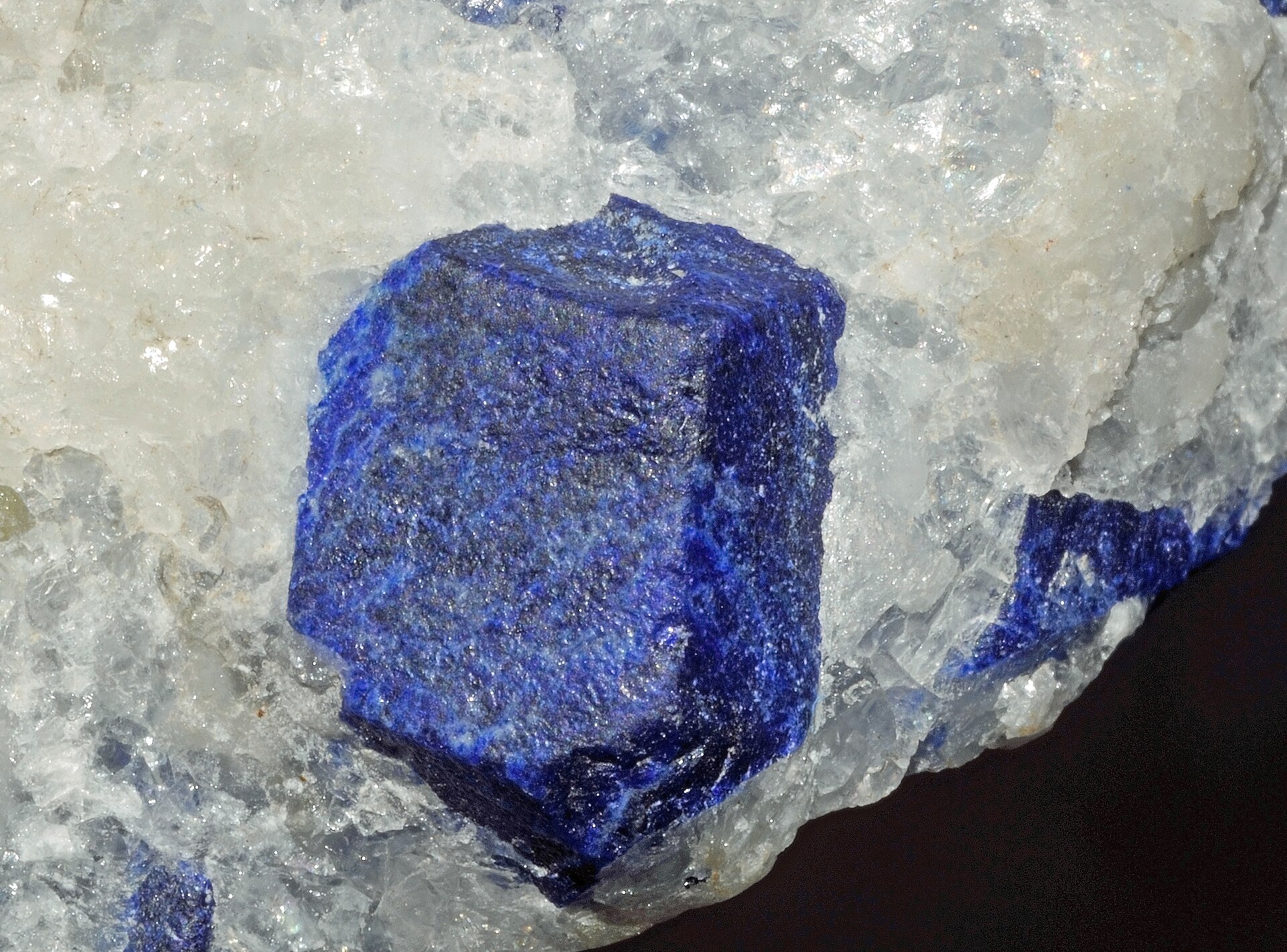
Lazurite (pure) — single crystals of the blue component, rare; mostly found in matrix.
Dyed lapis — cheap calcite-rich material dyed with Prussian blue or other agents; identifiable by white spots that absorb dye and by colour bleeding into acetone or alcohol.
Lapis simulants — synthetic spinel ("Gilson lapis"), dyed howlite or magnesite (cheap), reconstituted lapis (powder + resin).
How to identify
Genuine lapis lazuli identification:
- Deep blue colour with golden pyrite flecks and white calcite veining — natural specimens always show these inclusions; uniformly perfect blue without inclusions is suspicious.
- Hardness 5–6 — softer than quartz; scratches with a steel knife.
- Specific gravity 2.7–2.9 — distinguishable from heavier blue stones (sodalite SG 2.3, sapphire 4.0).
- Light blue streak when scratched on unglazed porcelain.
- Does NOT effervesce in acid (lazurite is silicate, not carbonate) — useful test vs dyed calcite.
- Acetone test: dyed lapis loses colour onto a cotton ball soaked in acetone; natural lapis is colour-stable.
Common confusions: sodalite (lighter blue, less or no pyrite, lower SG), dumortierite (more violet, fibrous), dyed jasper or howlite (uniform unnatural blue, acetone test positive), synthetic Gilson lapis (too perfect blue, no real pyrite — only embedded brass flecks).
Meaning & metaphysical properties
Lapis lazuli is the foremost stone of wisdom, truth and royal authority in modern metaphysical traditions, associated with the throat and third-eye chakras. It is used for spiritual insight, intellectual clarity, honest communication, and connection to ancient wisdom traditions. Many practitioners consider it the highest expression of the "Stone of Heaven" — a mediator between earth and spiritual realms.
The historical associations are extraordinary: lapis appears in nearly every ancient civilisation's most sacred objects. Egyptian high priests wore lapis amulets; the burial mask of Tutankhamun is inlaid with Afghan lapis transported 4,000 km across the Bronze Age trading network. Renaissance painters ground lapis into the legendary ultramarine pigment, used to paint the Virgin Mary's robes — by Vatican decree, only "true ultramarine" lapis pigment was permitted for sacred imagery, making the painters' contracts specify quality by ducats of pigment.
Care & cleaning
Lapis lazuli is relatively fragile and requires gentle handling:
- Avoid ultrasonic and steam cleaners — vibrations can split the rock along calcite veining.
- Clean only with damp soft cloth + mild neutral soap.
- Avoid acid (even mild like lemon juice) — calcite components dissolve.
- Avoid prolonged sunlight — the blue colour can slowly fade over decades of UV exposure.
- Avoid chlorinated water, perfume, hairspray, cosmetics — surface dulls and pyrite tarnishes.
- Store separately — softer than quartz, scratches easily.
Reserve lapis jewellery for occasional wear (pendants, earrings) rather than daily rings. Re-polish every few years to restore lustre.
Gallery
Looking to buy a lapis lazuli specimen?
Our small curated catalogue of lapis lazuli specimens is published on Etsy with worldwide shipping.
Browse Gemsprings on Etsy