Overview
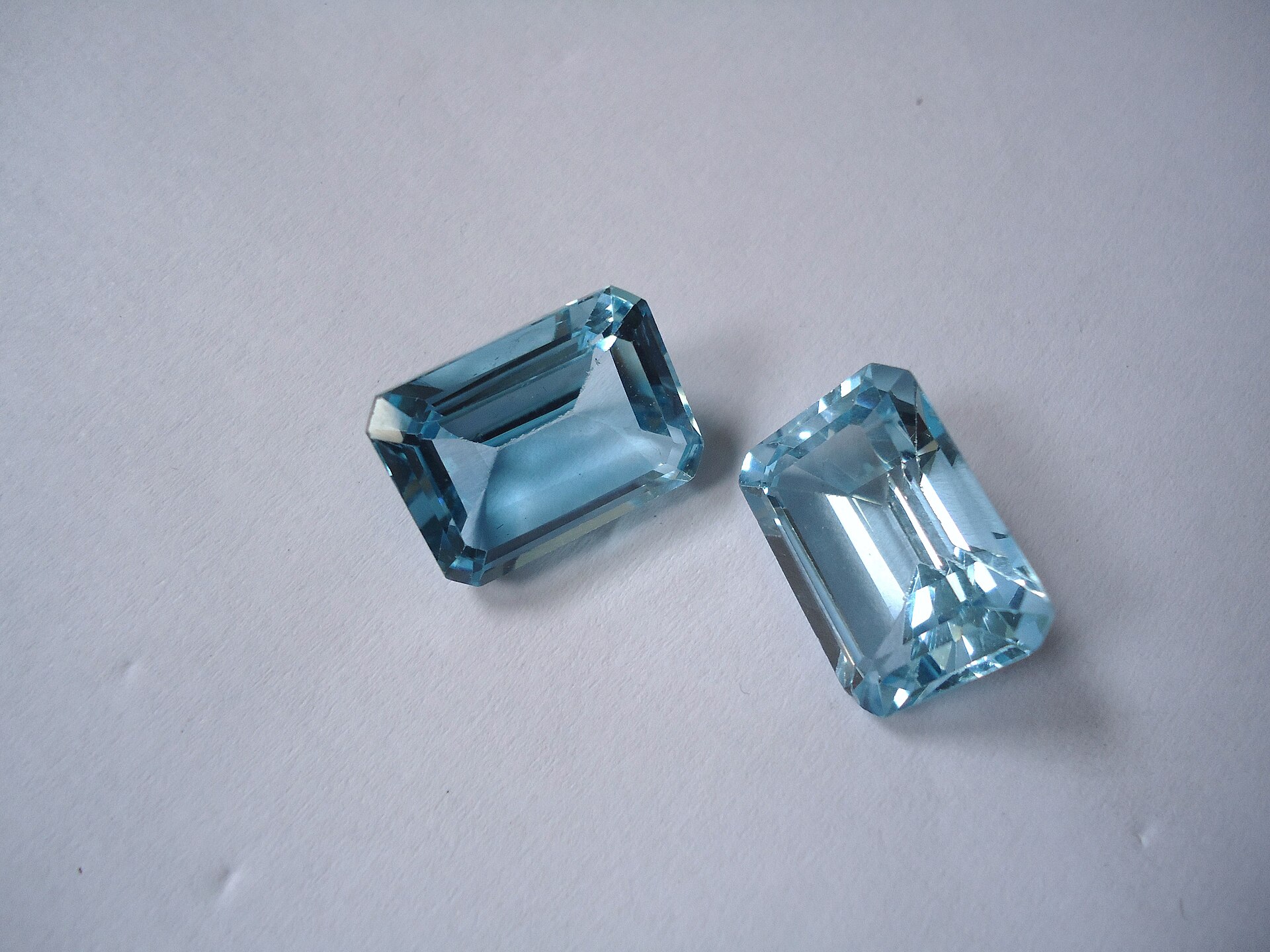
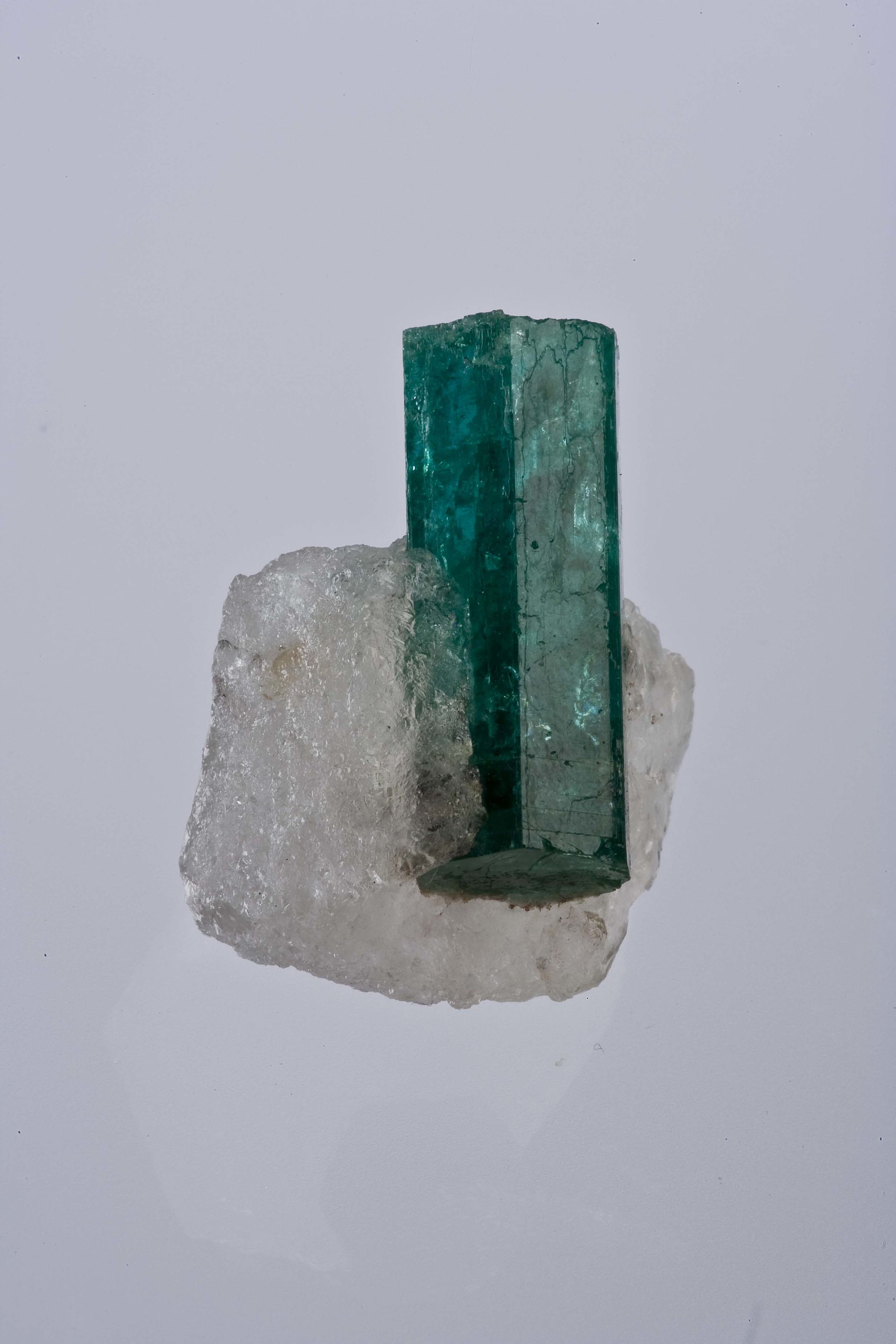
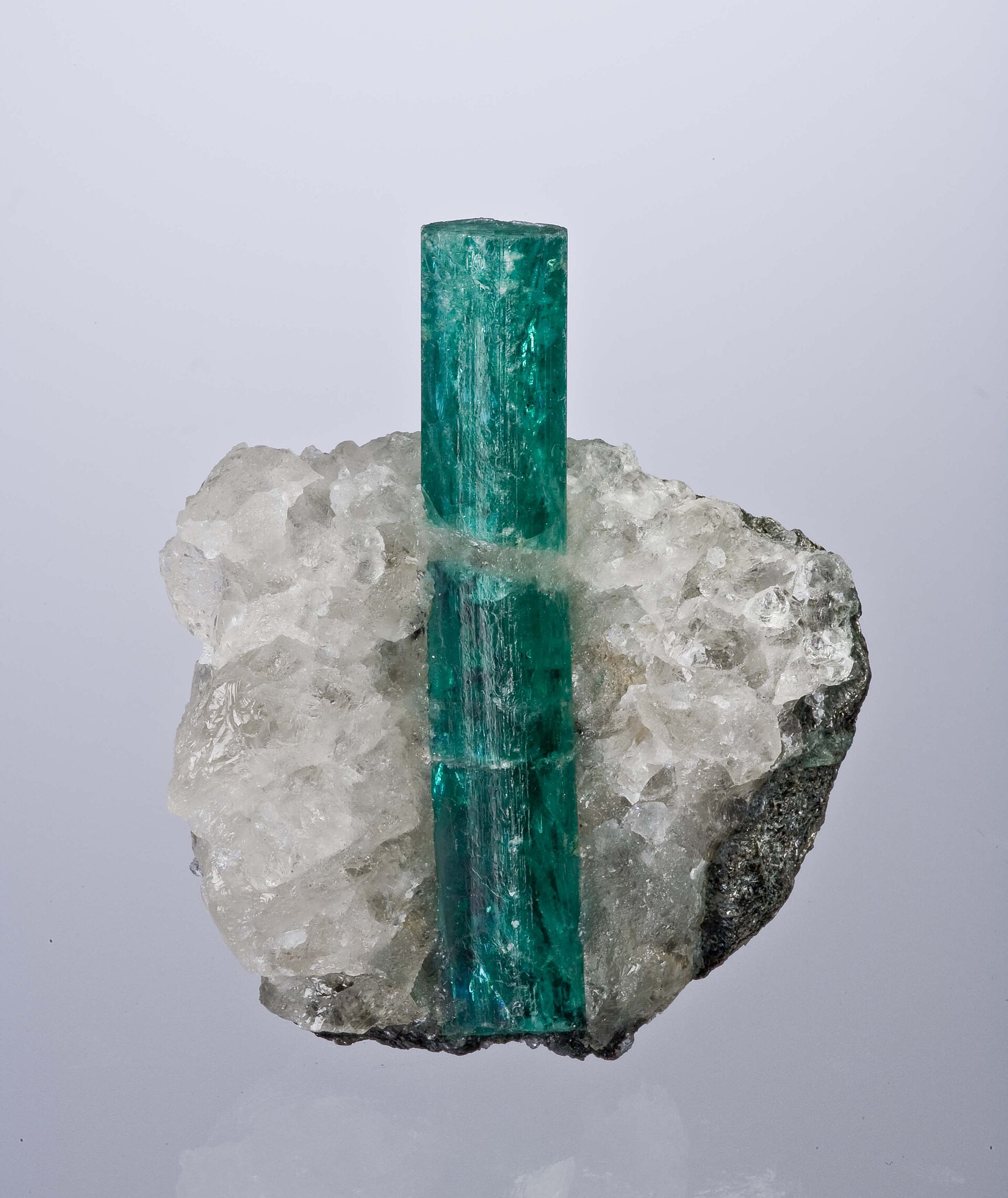
Emerald is the green gem variety of beryl (Be₃Al₂Si₆O₁₈), coloured by trace amounts of chromium and/or vanadium substituting for aluminium in the lattice. It has been mined and prized for at least 5,000 years — Cleopatra's emerald mines in Egypt's Eastern Desert (modern-day Sikait and Zabara) are among the world's oldest documented gem operations. Today the global benchmark is Colombian emerald, particularly from the Muzo and Chivor mines, which produce the saturated bluish-green tone known to gemmologists as "old mine" colour.
Emerald is famously included — gem-quality stones almost always show a fine network of internal fractures and crystal inclusions affectionately called the *jardin* ("garden"). These inclusions are not defects but identity markers: a perfectly clean "emerald" is almost certainly synthetic or another gemstone. Most natural emeralds are oiled or resin-filled to improve apparent clarity, a treatment that is universally accepted in the trade but must be disclosed.
Formation
Emerald requires an unusual geological coincidence: beryllium (extremely rare in continental crust, ~3 ppm) must meet chromium or vanadium (concentrated in ultramafic and black-shale rocks) under conditions that allow crystallisation. Most economically significant emerald deposits formed where beryllium-bearing hydrothermal fluids percolated through Cr/V-rich host rocks.
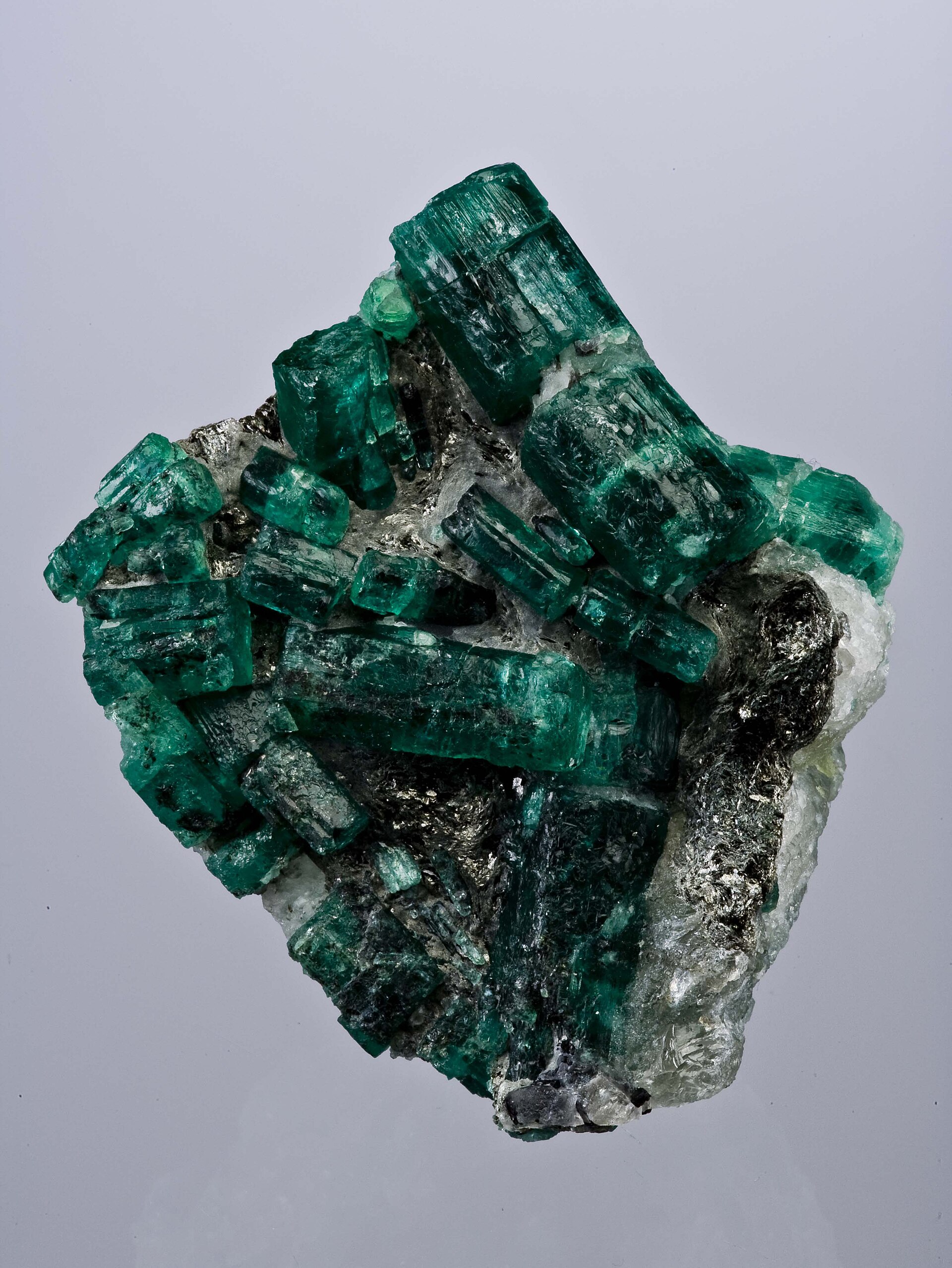
Colombian-type deposits are unique: they formed at relatively low temperatures (~300–360 °C) in sedimentary black shales of the Eastern Cordillera, where evaporite-derived brines mobilised beryllium from underlying layers and chromium from the host shale. The result is exceptionally clean, vivid emerald with low iron content (iron dulls the green).
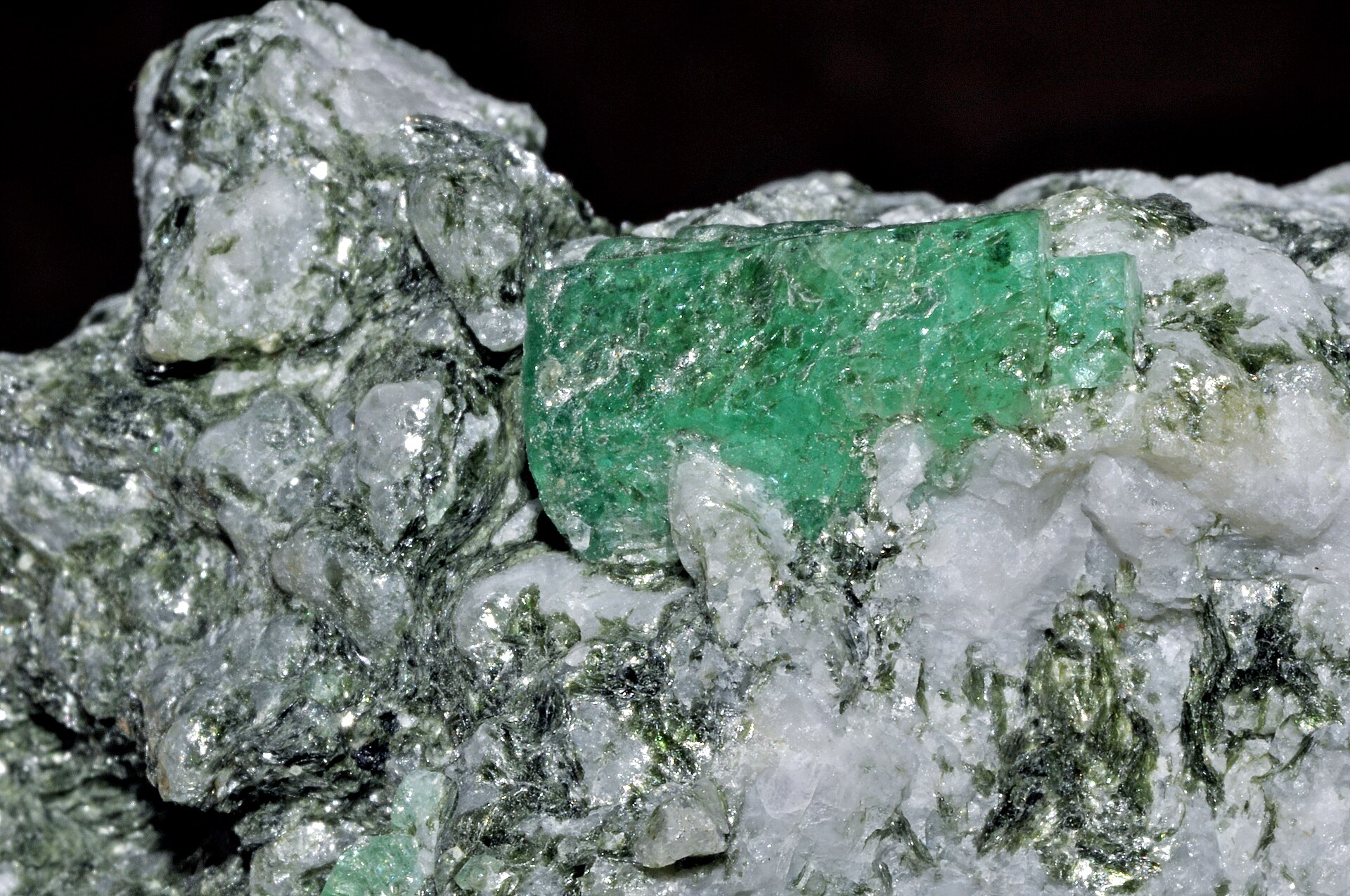
Schist-hosted deposits (Zambia, Brazil, Russia, Pakistan) formed at higher temperatures (~500–600 °C) at the contact between beryllium-rich pegmatites and chromium-rich serpentinites or biotite schists. These tend to produce slightly bluer-green emerald with more inclusions.
Varieties
Colombian emerald — the global reference; vivid pure-green to slightly bluish-green tone, low iron, often with three-phase inclusions (gas + liquid + solid) diagnostic of Colombian origin.
Zambian emerald — saturated bluish-green, generally cleaner than Colombian, higher iron content, since 1980s the dominant production by volume.
Brazilian emerald — paler yellow-green typically, large stones available from Bahia and Minas Gerais.
Trapiche emerald — rare variety with six dark spokes radiating from a hexagonal core, formed by simultaneous growth of emerald and graphite/feldspar. Only found in Colombia.
Ethiopian emerald — discovered 2016 at Shakiso; bright green tone competing with Zambian quality.
Russian (Ural) emerald — historically important, mined since 1830; today minor production.
Hydrothermal synthetic emerald — lab-grown by Chatham, Biron, Tairus; visually convincing but identified by anomalous inclusions and spectroscopy.
How to identify
Identifying genuine natural emerald:
- Hardness 7.5–8 — scratches glass; cannot be scratched by topaz.
- Refractive index 1.565–1.602 — birefringence 0.005–0.009 (uniaxial negative).
- Specific gravity 2.67–2.78 — heavier than glass imitations.
- Pleochroism: blue-green and yellow-green visible when rotated.
- Filtering with Chelsea filter: most natural emerald appears red; some Colombian shows the strongest reaction.
- Inclusions: jardín pattern (almost always present in natural stones); three-phase inclusions specific to Colombian origin.
- UV fluorescence: weak to none (synthetic flux-grown emerald often fluoresces stronger).
Common simulants: green glass paste (singly refractive, lower SG, bubbles), synthetic spinel (different RI, no pleochroism), green tourmaline (slightly different pleochroism, harder Mohs 7), chrome diopside (lower hardness 5.5–6, distinct cleavage), demantoid garnet (singly refractive, much higher dispersion).
Always request a GIA, AGL, GRS or SSEF report for stones over 1 ct — these labs identify origin (Colombian vs Zambian premium varies 2-3x) and disclose treatments.
Meaning & metaphysical properties
In modern metaphysical traditions, emerald is associated with the heart chakra and is considered the stone of unconditional love, compassion, friendship and emotional balance. It is recommended for partnership work, fertility and prosperity in business — many ancient cultures considered it a stone of foresight and revealed truth.
Egyptian Pharaohs were buried with emeralds for protection in the afterlife; Cleopatra is said to have gifted emeralds carved with her likeness. In Vedic astrology emerald is the gem of Mercury (*Budh*) and is recommended for wisdom and communication. In medieval Christian Europe emerald was associated with the Holy Grail (according to one legend the Grail was carved from a single emerald that fell from Lucifer's crown).
Care & cleaning
Emerald is fragile despite its hardness — the jardín inclusions create internal stress points where the stone can crack from impact or thermal shock. Strict care rules:
- Never use ultrasonic or steam cleaners — vibrations and heat cause crack propagation and remove the protective oil treatment.
- Clean only with lukewarm water + neutral soap + soft brush.
- Avoid sudden temperature changes (don't move from freezer to hot water).
- Re-oil periodically every 3–5 years if the stone was originally oiled (a jeweller can do this).
- Avoid acid, chlorine, perfume, hairspray — they dissolve the resin filling.
Set emerald in protective settings (bezel preferred over prong) for ring use. Reserve for occasional wear if possible.
Gallery
Looking to buy a emerald specimen?
Our small curated catalogue of emerald specimens is published on Etsy with worldwide shipping.
Browse Gemsprings on Etsy