Overview
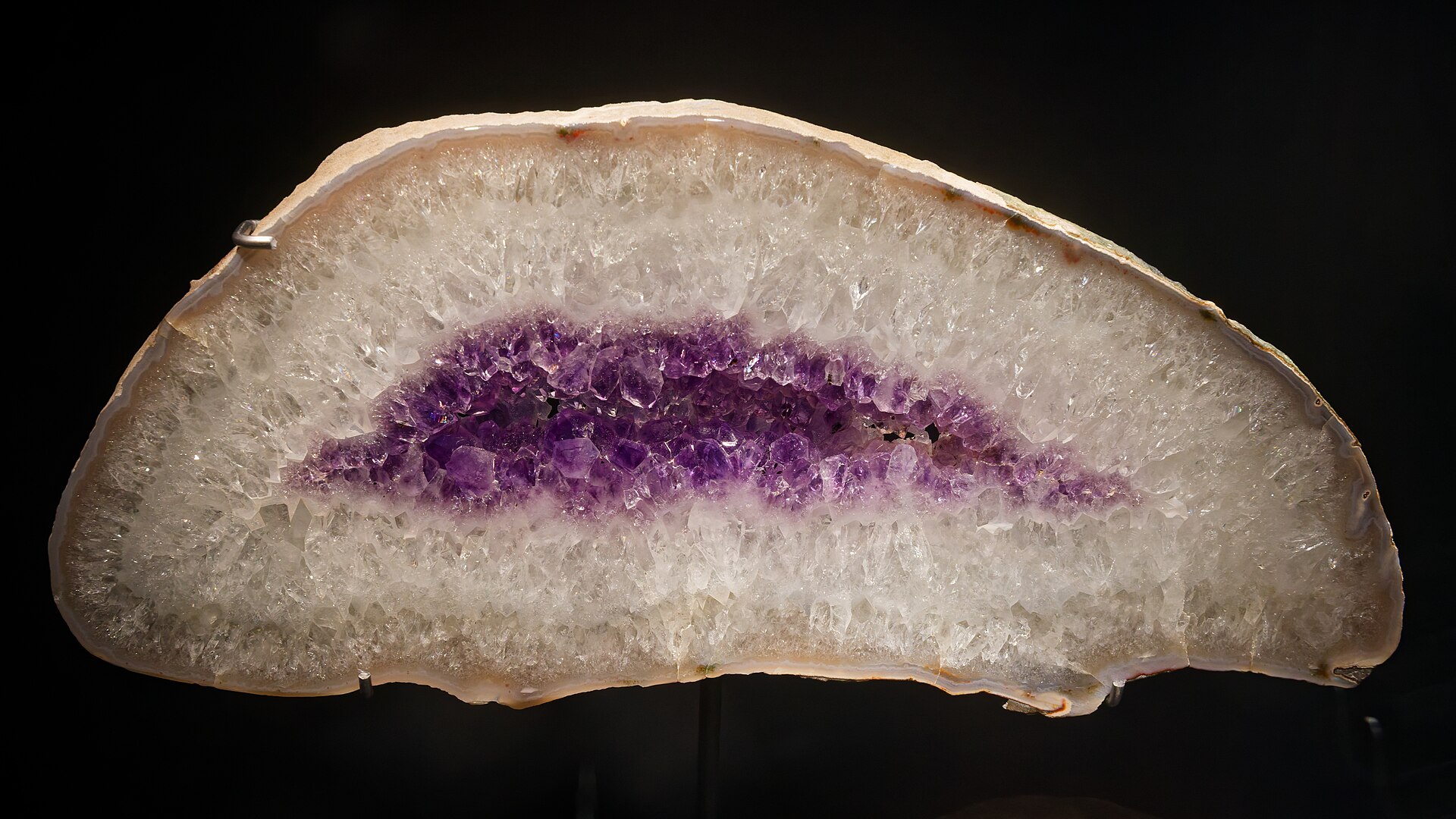
Amethyst is the most prized variety of macrocrystalline quartz, and one of the most recognised purple gemstones on earth. Its colour ranges from the palest lilac to the deep "Siberian" violet that has captivated jewellers since antiquity. Chemically it is silicon dioxide, the same compound as common rock crystal, but its violet hue comes from trace iron (Fe³⁺/Fe⁴⁺) within the crystal lattice combined with natural gamma irradiation from surrounding rocks.
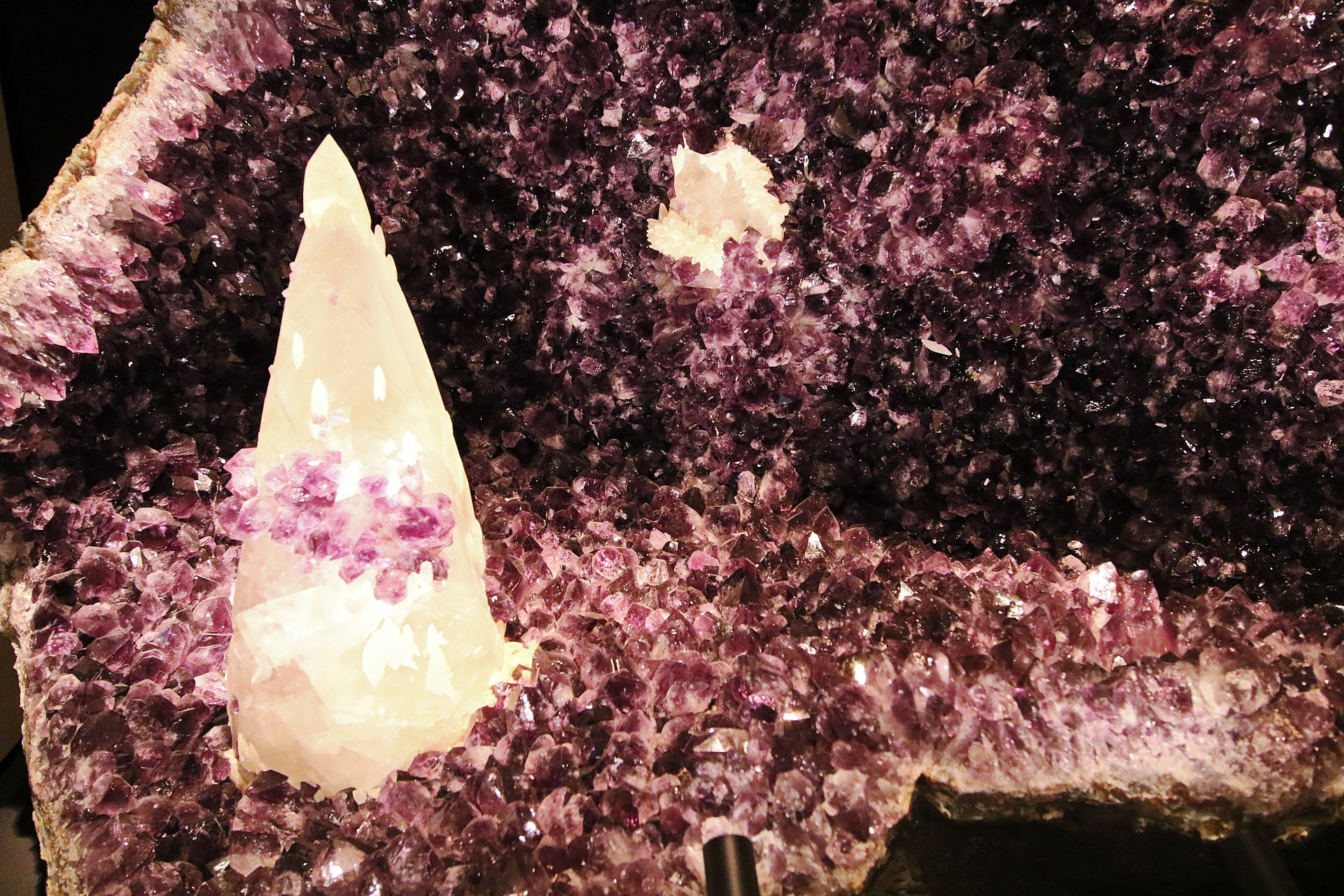
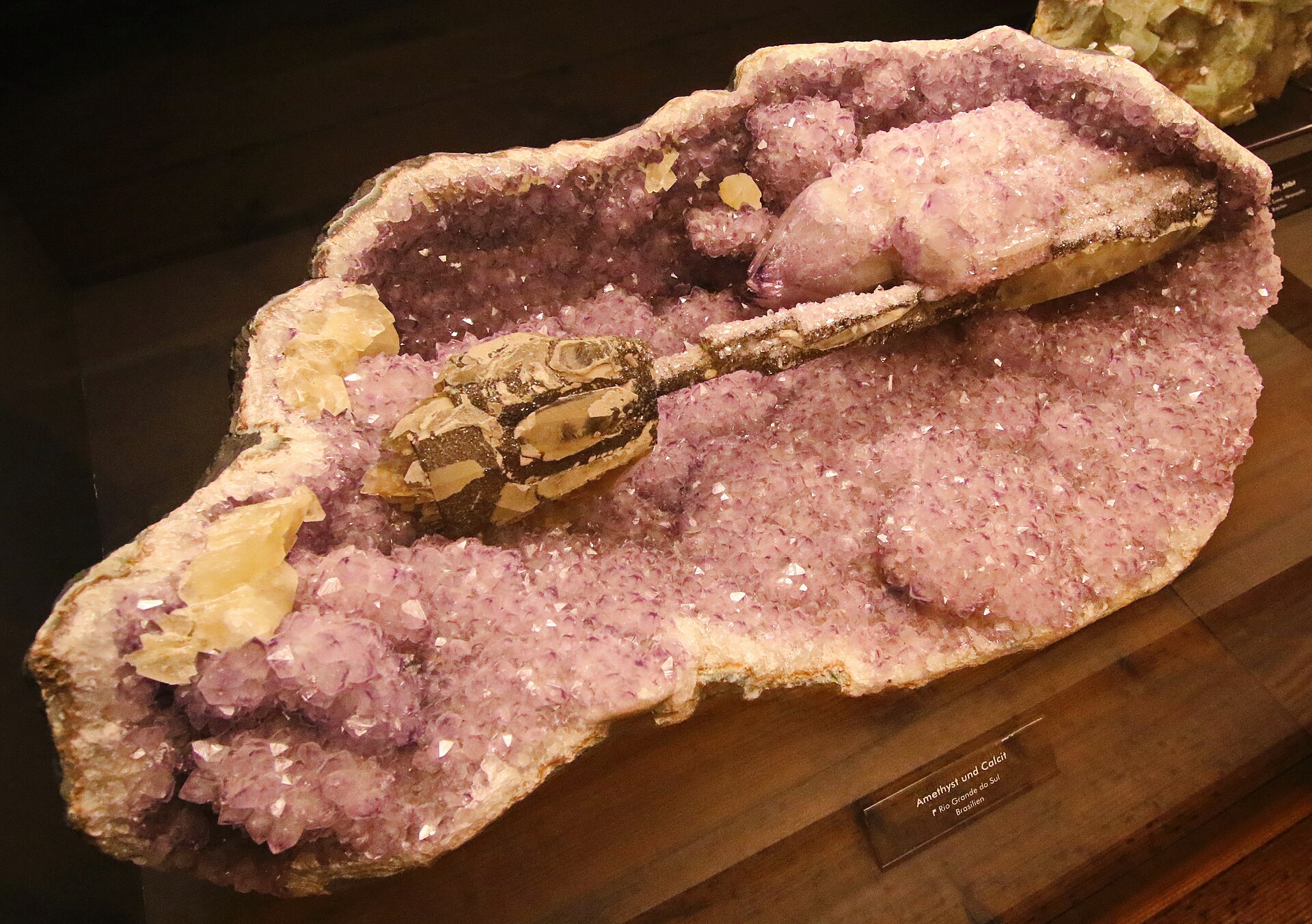
Amethyst forms inside volcanic geodes and hydrothermal veins, growing as terminated hexagonal prisms that line cavities in basalt and granite. The most spectacular deposits are the great geode mines of Artigas in Uruguay and Ametista do Sul in Rio Grande do Sul, Brazil — where amethyst-lined cavities the size of small rooms are extracted from basaltic flows that erupted some 130 million years ago.
Formation
Amethyst crystallises in cavities (vugs and geodes) at relatively low temperatures, generally between 50 and 350 °C, from silica-rich hydrothermal fluids. As the fluid cools, dissolved SiO₂ precipitates onto the cavity walls, with quartz crystals growing inward. Trace iron is incorporated into the lattice; later, gamma radiation from nearby radioactive minerals (typically potassium feldspars) gradually shifts the iron's oxidation state, producing the characteristic violet colour over millions of years.
The famous Brazilian and Uruguayan amethyst geodes formed inside ancient basalt lava flows: gas bubbles trapped in the cooling magma created cavities, which were later filled with silica-bearing groundwater. Heating amethyst above ~500 °C destroys the colour centres, converting it irreversibly to yellow citrine — this is in fact the origin of most commercial "citrine" on the market.
Varieties
Siberian amethyst — the most saturated, deep purple with red and blue flashes; historically from Russia's Mursinka deposit.
Uruguayan amethyst — uniform deep violet, often with darker tips; from Artigas geodes. Generally considered the highest quality currently mined.
Brazilian amethyst — paler to medium violet, very abundant; from Ametista do Sul and Rio Grande do Sul.
Zambian amethyst — saturated reddish-purple with blue flashes; often eye-clean and suitable for faceting.
Rose de France — pale lilac to pinkish-mauve amethyst, low saturation, very affordable.
Chevron / banded amethyst — alternating bands of purple amethyst and white quartz, common in some Indian and African deposits.
Ametrine — natural bicolour with one half amethyst (purple) and the other citrine (yellow); only commercial source is the Anahí mine in Bolivia.
How to identify
Genuine amethyst can be confirmed by:
1. Hardness 7 — scratches glass and steel; cannot be scratched by a steel nail.
2. Specific gravity ≈ 2.65 — feels lighter than glass imitations of the same size.
3. Refractive index 1.544–1.553 — gives the characteristic doubled edges visible under a loupe.
4. Conchoidal fracture — broken surfaces curve like glass, not stepped.
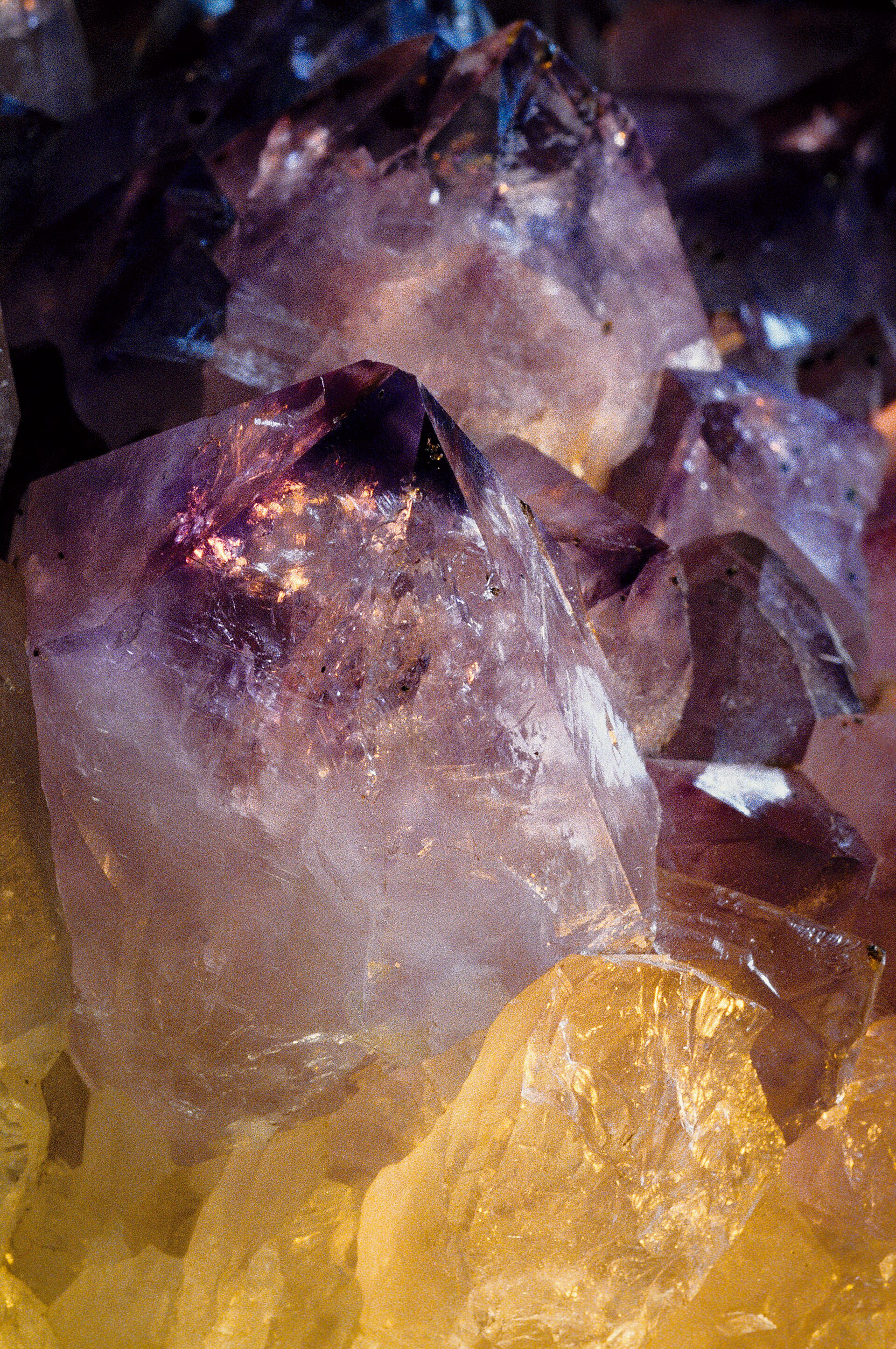
5. Colour zoning — natural amethyst frequently shows banded or pyramidal colour zoning visible at the crystal terminations under a loupe.
Common imitations include purple glass (lower hardness, single refraction, often perfect bubbles inside), synthetic amethyst (visually indistinguishable to the eye but identifiable by a gemologist via twinning and infrared spectroscopy), and heat-treated dyed quartz (colour concentrates along fractures).
Meaning & metaphysical properties
In contemporary crystal healing and metaphysical traditions, amethyst is associated with the crown and third-eye chakras and is considered the foremost stone of spiritual awareness, clarity and protection from psychic harm. It is said to enhance intuition, soothe overactive thought patterns, and support meditation. Historically, ancient Greeks believed amethyst could prevent intoxication — the name itself derives from the Greek *amethystos*, "not drunken" — and drinking vessels carved from amethyst were used at symposia for this reason.
In Tibetan and Buddhist traditions amethyst is one of the stones used in malas; in medieval Christian Europe it was set into bishops' rings, where it remains today the traditional ecclesiastical stone of episcopal authority. Modern practitioners commonly place amethyst clusters in bedrooms to encourage restful sleep, and carry small tumbled pieces to dispel anxiety.
Care & cleaning
Amethyst is durable enough for everyday wear, but its colour can fade if exposed to prolonged strong sunlight or temperatures above approximately 200 °C. Avoid leaving amethyst in a sunny window for months, and never expose it to a jeweller's torch.
Clean with warm soapy water and a soft brush. Ultrasonic and steam cleaners are generally safe for solid pieces but should be avoided if the stone is fractured, included or has been dyed. Store separately from harder stones (topaz, sapphire, diamond) to prevent surface scratching.
Gallery
Looking to buy a amethyst specimen?
Our small curated catalogue of amethyst specimens is published on Etsy with worldwide shipping.
Browse Gemsprings on Etsy